
Search marketing spent two decades on a question of order. Given that everyone is in the index, who appears first.
Every technique in the discipline assumes that premise. Keyword targeting, internal linking, backlink acquisition, page speed - all of it operates on relative position among documents that are already present and already readable.
This desk documents the premise coming apart from four directions at once.
Rank asks where you sit among documents that are present. Every finding on this desk is about whether you are present at all.
Why the distinction was invisible before
Presence used to be free and automatic. You published a page, a crawler found it, and it entered the index. The only interesting question was position, so the discipline built itself entirely around position - and the vocabulary followed. Rankings. Positions. Competitors. Share of voice. Every term describes relative order.
Three things made presence a decision rather than a default.
Crawling became contested. Feature 28's split between training and search crawlers means access is no longer one permission but several, each with different returns and each grantable separately.
Rendering became conditional. A document served as a shell is present as a URL and absent as content. Feature 30's case is extreme; the class is ordinary.
Retrieval replaced ranking for a growing share of answers. The Content desk's Feature 22 found four in five language-model citations coming from pages outside the top hundred. A retrieval system does not need you to rank. It needs you to exist, in readable form, containing an extractable claim.
What this implies for how the work is ordered
If presence is a precondition and position is a refinement, the sequence most organisations run is inverted.
The right-hand column is cheaper than the left. That is the part worth noticing. Steps one and two cost hours and require no budget approval; step three costs a baseline measurement. The expensive work is unchanged - it simply now sits behind three cheap checks that determine whether any of it can work.
The honest state of the discipline
Four things this desk could not establish, and they matter more than most of what it could.
Whose interest this serves
This desk concludes that technical presence work - audits, crawler policy, rendering checks - has become the precondition for everything else. Marketing Legendary sells exactly that work. It is the most commercially convenient conclusion available from these findings. Two things offered against it: the three checks recommended above require no vendor and take hours, and Feature 31 proposes holding search functions to standards that are harder to satisfy than the traffic targets they currently miss. Neither makes the conclusion disinterested. Both make it checkable.
What survives every scenario
The uncomfortable feature of this desk is how much of it is unresolved. The remedies may be stayed. The blocking wave may reverse. The growth rates may decay. Any confident plan built on a single outcome here is a bet.
So it is worth asking which actions are correct across all of the plausible outcomes, because those are the ones to take now.
The left column is unglamorous, cheap and entirely within an organisation's control. The right column is where the strategic conversations happen and where almost all the attention goes.
That inversion is the desk's practical finding. The actions that are unambiguously correct are the ones nobody is discussing, and the ones being discussed all depend on outcomes nobody knows.
What to do about it
Run the presence checks before the next content brief. Served-document inspection, crawler policy review, citation baseline. All three this month, none requiring approval.
Stop reporting a single organic number. Conventional search and AI answering have different leaders, different trajectories and different mechanics. One line collapses them and hides which is moving.
Name the owner of every input in Feature 31's Figure 01. The exercise produces the escalation argument by itself.
Watch two dates on the antitrust case. Whether a stay is granted, and when the Technical Committee publishes licence terms. Neither will be reported by search marketing publications and both change the market's shape.
Assume presence is now a maintained property. It used to be a one-time achievement. A deployment can remove you from consideration without any visible symptom, which means the check belongs in the release process rather than in an annual audit.
| Finding | Value | Feature |
|---|---|---|
| Market structure | ||
| Remedies decision | 2 Sept 2025 | 27 |
| Chrome divestiture | Rejected | 27 |
| Data-sharing regime triggered | 3 Mar 2026 | 27 |
| Licence terms finalised | No | 27 |
| Google appeal filed | 20 Jan 2026 | 27 |
| Presence | ||
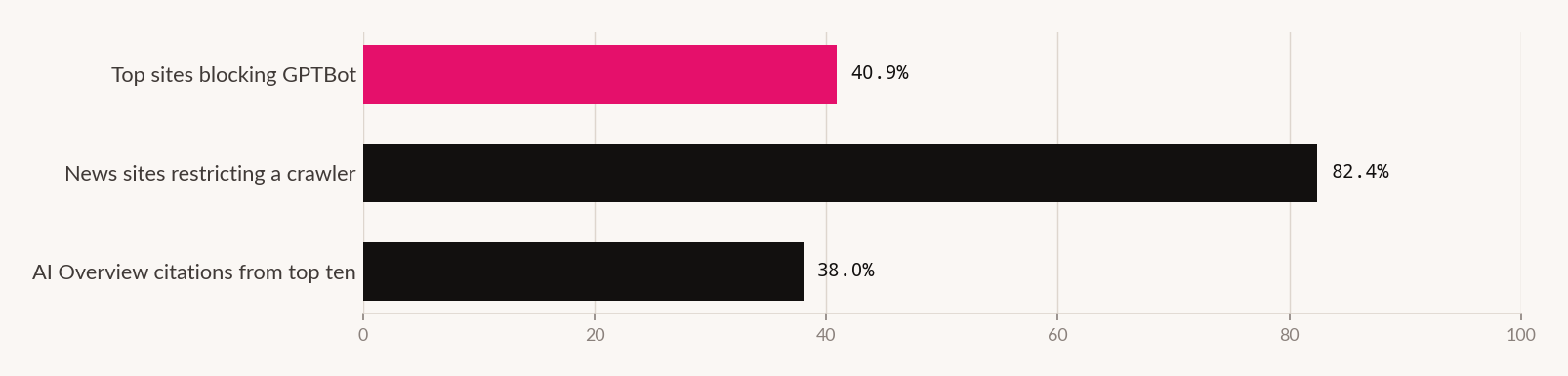
| Top 1,000 sites unreadable to GPTBot | 40.9% | 28 |
| News sites restricting an AI crawler | 82.4% | 28 |
| DOM nodes served, audited site | 28 | 30 |
| Where to be present | ||
| Google conventional search share | 89.87% | 29 |
| Google share of referrals | 87.6% | 29 |
| ChatGPT chatbot share | 64.5–68% | 29 |
| Perplexity user growth | +370% | 29 |
| Perplexity referral share vs Gemini | 7.67% vs 7.03% | 29 |
| Not established anywhere on this desk | ||
| Incidence of rendering failure | - | No study |
| Whether blocking helps the blocker | - | No study |
| Whether the remedies will function | - | Unresolved |
| Revenue effect of any of it | - | No research |
How we did this
What this doesn't prove
- That presence work improves outcomes. It is a necessary condition, which is a weaker claim than sufficiency and the only one the evidence supports.
- That the four findings are one problem. The reduction is an editorial argument. They could equally be four unrelated changes arriving together.
- That position work has stopped mattering. Google still holds 89.87% of conventional search and ranking still supplies a fifth of LLM citations.
- Any revenue effect. Named as the fourth gap. Nothing on this desk or the Content desk connects any of these measures to a commercial outcome.
- That the recommended sequence outperforms the conventional one. Untested. It is ordered by cost and by necessity, not by demonstrated return.
- Anything about markets outside those measured. Share and blocking data are heavily US and English-language weighted.
Sources for this feature
- Features 27, 28, 29, 30 and 31 of this desk. Another feature in this edition - all external sourcing and grading carried from those features
- Features 21, 22 and 23 of the Content desk. Another feature in this edition