
Every year System1 runs the Cannes Lions Film winners through the same consumer test it applies to ordinary advertising. Real people watch the ad and register emotional response second by second. The output is a Star Rating between 1.0 and 5.9, predicting long-term brand growth potential.1
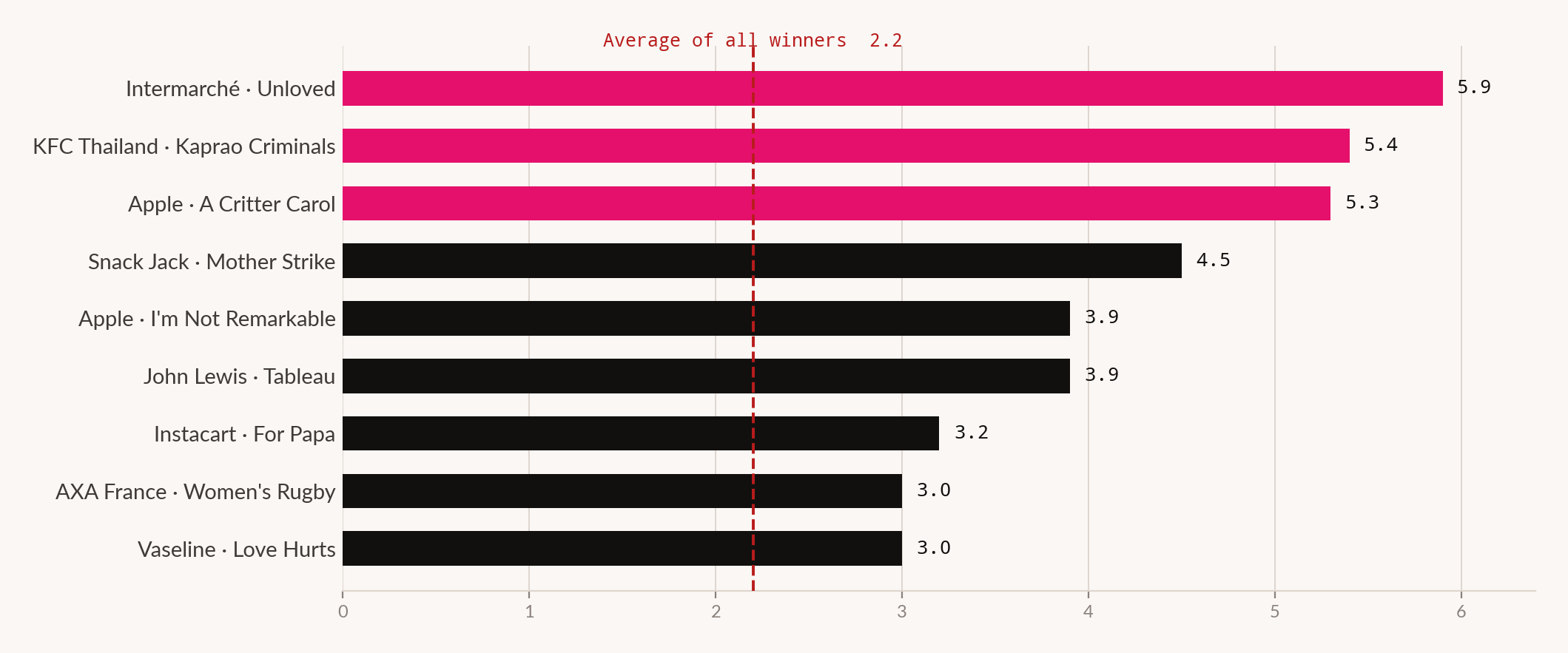
In 2026, one winner hit the ceiling. Intermarché's "Unloved" scored 5.9 - the maximum the scale allows. KFC Thailand's "The Kaprao Criminals" scored 5.4. Apple's "A Critter Carol" scored 5.3.1
The average across all winners was 2.2.1
The arithmetic nobody publishes
The nine winners System1 named individually average 4.2. The full field averages 2.2.
Those two facts cannot both describe the same distribution unless the unpublished remainder sits substantially below 2.2. We do not know how many Film winners there were in total, so we cannot state the remainder's average. But the direction is arithmetically forced regardless of field size: the winners that did not make the published ranking scored badly enough to drag a 4.2 top-nine down to a 2.2 overall.
This is not an awards system that produces mediocre work. It is one that produces both the best-tested ad of the year and a long tail scoring near the floor, and calls them the same thing.
System1 notes this is not new: it has tracked award-winning advertising performing below broader advertising norms with consumers since 2010.1 Sixteen years of the same divergence is a structural property, not a bad year.
Whose interest this serves
System1 sells creative pre-testing. A finding that awards fail to predict consumer response is a finding that advertisers need a different test - specifically, theirs. The data appears methodologically consistent and is published with named scores against a disclosed scale, which is more than most of this category offers. But the conclusion is commercially convenient for the party producing it, and we are not going to present it as a neutral observation.
The strongest objection, taken seriously
There is a good defence of Cannes here and it deserves stating properly rather than being waved at.
The Film Lions do not claim to award effectiveness. They award craft, idea and execution. Cannes runs an entirely separate prize - the Creative Effectiveness Lion - for work judged on business results, won this year by Axa's "Three Words" with Publicis Conseil, Paris.2 Criticising a craft award for not predicting consumer response is, on this reading, a category error. It is like complaining that a prize for cinematography failed to forecast box office.
We think that objection is largely correct, and it is why this feature is not headlined "Cannes is broken". It isn't. It is doing what it says.
The problem is not the award. The problem is what happens downstream of it. Award-winning work is used as a reference standard in pitches, in creative reviews, in "here is the kind of thing we should make" decks. A body of work selected for craft is routinely repurposed as evidence of what performs. The awards did not make that claim. The industry made it on their behalf.
What the top scorers had that the rest did not
The interesting question is not why the average is low. It is what distinguishes a 5.9 from a 2.2 when both were judged excellent by expert juries.
System1's reading of the top performers is that they combined warmth, entertainment and emotional payoff.1 Coverage of the same results was blunter: craft and humour outperformed the year's dominant theme.3
Note what is not on that list. Not novelty. Not technological ambition. Not the year's most-discussed theme. In a Cannes cycle dominated by conversation about AI, the work that moved consumers was warm, funny and well made.3
That is worth sitting with, because it is the opposite of how creative ambition is usually signalled. Craft and humour are not what a team pitches when it wants to look forward-thinking. They are, on this evidence, what worked.
The medals do not track the scores either
One detail in the published ranking is easy to miss. The three highest consumer scores went to two Bronzes and a Silver. Intermarché at 5.9 and KFC Thailand at 5.4 were both Bronze winners.1
We only have nine scores, so we cannot claim that lower medal tiers systematically outperform higher ones - that would need the full field. But within what was published, medal rank and consumer response are not aligned. The jury's ordering and the audience's ordering are different orderings.
A second awards system, judged differently
Run the same year through a scheme built on consumer reaction rather than jury opinion and a different set of names appears.
Kantar's 2026 Advertising Effectiveness Awards - described as judged on the reactions of real people - gave top honours to CeraVe, Heinz and McVitie's, across 36 winning brands in four categories.4
The Kantar winners are instructive by their character. CeraVe, Heinz and McVitie's are mass-market brands in unglamorous categories. This is not the register of work that typically dominates award-show conversation, and that is precisely the point: a scheme that selects on consumer reaction surfaces different work than one that selects on craft. Neither list is wrong. They are answers to different questions.
Kantar's own stated conclusion is that effectiveness comes from creative and media working together4 - which is a claim about system rather than about the film, and one no craft award is structured to assess. Kantar has also run a collaboration with Saïd Business School analysing how creative quality and brand strength interact.4
What to do about it
Stop using award reels as performance evidence. Use them for what they are: a library of craft. If someone in a review says "this won at Cannes" as an argument that it worked, that inference is not supported - and on this data, the average award-winning film tests at 2.2.
Test your own work against the same scale you judge others by. The dispersion in Figure 01 is the actual finding. Excellent work and floor-scoring work both won. Which one you have made is not determinable from the enthusiasm of the room.
Take warmth, humour and payoff seriously as strategy, not decoration. They are what the top scorers shared, in a year when the industry conversation was about something else entirely. This is the cheapest recommendation in this edition to act on and the one most likely to be dismissed as unambitious.
Separate the craft question from the effect question explicitly. Cannes does this - Film Lions and Creative Effectiveness Lions are different prizes. Most creative reviews do not, and collapse both into "do we like it".
Discount every source here by its interest, including the ones you agree with. System1 sells testing. Kantar sells effectiveness measurement and runs the competing awards. Both produced useful, methodologically disclosed data. Neither is neutral.
| Measure | Value | Grade |
|---|---|---|
| Cannes Lions 2026 Film winners, System1 tested | ||
| Intermarché, "Unloved" (Bronze) | 5.9 | Reported |
| KFC Thailand, "The Kaprao Criminals" (Bronze) | 5.4 | Reported |
| Apple, "A Critter Carol" (Silver) | 5.3 | Reported |
| Snack Jack, "Mother Strike" (Bronze) | 4.5 | Reported |
| Apple, "I'm Not Remarkable" (Silver) | 3.9 | Reported |
| John Lewis & Partners, "Tableau" (Silver) | 3.9 | Reported |
| Instacart, "For Papa" (Silver) | 3.2 | Reported |
| AXA France, "Nothing Stops Women's Rugby" (Silver) | 3.0 | Reported |
| Vaseline, "Love Hurts" (Bronze) | 3.0 | Reported |
| Aggregates | ||
| Average, all Film winners | 2.2 | Reported |
| Average, the nine named above | 4.2 | Our arithmetic |
| Award work below advertising norms, tracked since | 2010 | Reported |
| Other outcomes | ||
| Creative Effectiveness Grand Prix | Axa, "Three Words" - Publicis Conseil, Paris | |
| Kantar Effectiveness Awards, top honours | CeraVe, Heinz, McVitie's - 36 winning brands | |
How we did this
What this doesn't prove
- That Cannes Lions is failing. The Film Lions award craft and say so. The misuse happens downstream, when craft awards are cited as effectiveness evidence.
- That Star Rating predicts sales. It is a vendor model of long-term brand growth potential. Its validity is System1's claim, and System1 sells the test.
- What the unpublished winners actually scored. We show the arithmetic forces them low. We do not know the field size and will not invent one.
- That lower medals outperform higher ones. Nine data points showed no alignment between medal rank and Star Rating. That is an observation about a small published subset, not a finding.
- That warmth and humour cause high scores. No source decomposes Star Rating into contributions from named traits. The characterisation is qualitative.
- That the two award schemes are comparable. Cannes and Kantar select on different criteria by design. Their divergence is expected, not scandalous - it is shown here to make the selection criteria visible.
- Anything about media weight. None of this addresses how much was spent behind any of these films, which Kantar's own conclusion suggests is inseparable from the outcome.
Sources for this feature
- System1 Group, Roaring Win for Film Craft at Cannes Lions 2026. system1group.com A named study, reported by someone else - vendor research, method disclosed
- Cannes Lions 2026 Creative Effectiveness winners. contagious.com, canneslions.com A named study, reported by someone else - organiser and trade
- Cannes vs. The Consumers: Craft and Humour Conquer AI. lbbonline.com From a company that sells into this market - trade coverage
- Kantar 2026 Advertising Effectiveness Awards, and Kantar with Saïd Business School on creative quality. kantar.com, themediaonline.co.za A named study, reported by someone else - vendor research, interested party