
Feature 06 of this edition described India's AI demand: 100 million weekly users, second in the world by volume, 76th by per-capita usage. Enormous consumption, thinly spread.
This is the other side of the ledger, and it is less flattering. India consumes AI at superpower scale. It builds AI at almost none - and the three constraints preventing that from changing are measurable, documented, and largely unaddressed.
The domicile problem
Of the world's top 100 AI companies, 20 have an Indian co-founder. India ranks first globally in AI skill penetration.1
Of those twenty companies, one is domiciled in India.
India is not short of people who can build frontier AI companies. It is short of reasons for them to build those companies in India.
This is a familiar pattern in Indian technology and it is usually discussed as a talent story. It is more useful read as a capital and infrastructure story, because founders locate where compute, capital and customers are - and on two of those three, the gap is quantified.
The capital gap
India AI funding in 2025 came in at roughly double the $627 million raised in 2024.1 A doubling is genuine momentum, and the composition is healthier than the headline: vertical AI grew 2.5× and now represents 37% of the funding mix - applied AI solving specific industry problems rather than foundation-model ambition.
But the absolute number is the point. India's entire AI funding year sits in the region of $1.2–1.4 billion. Individual US AI companies have raised more than that in a single round, repeatedly, across 2025 and 2026.
For a country generating roughly a tenth of global ChatGPT traffic, that is a striking mismatch between where AI is used and where AI is financed. India is currently a demand market being served almost entirely by supply built elsewhere.
The compute gap, which is the real constraint
The infrastructure numbers are the most consequential in the study, and they are not incremental.
India's AI compute demand is projected to reach approximately 7 gigawatts by 2030 - around thirty times current levels. The installed GPU base must rise from 216,000 to approximately 3.3 million, a fifteenfold increase.1
demand
Against that requirement sits $65 billion committed by hyperscalers and a stated $200 billion sovereign AI commitment. Even with the hyperscaler capital deployed, the study identifies a residual sovereign compute gap - capacity that commercial cloud providers will not serve, because the workloads are strategically sensitive, economically unattractive, or both.
That residual is where the policy argument lives. A country can rent inference capacity from foreign hyperscalers indefinitely and still have a functioning consumer AI market. What it cannot do on rented capacity is train sovereign models on sensitive data, guarantee continuity under geopolitical stress, or set its own terms on cost.
Why a fifteenfold GPU build is harder than it sounds
Compute build-outs are usually discussed as a procurement problem. They are mostly a power and land problem.
Seven gigawatts of AI demand is not a data-centre line item; it is a national energy planning question, competing directly with industrial and residential load in a grid that already manages seasonal stress. Thirty times current consumption inside five years requires generation, transmission and cooling infrastructure that has to be commissioned years before the GPUs arrive.
The GPU number gets the headlines because it is easy to state. The gigawatt number is the one that determines whether the GPU number is achievable.
The execution gap: a quarter of enterprises are stuck
The third constraint is organisational, and the study's enterprise survey of 100+ Indian CXOs produces the most operationally useful finding in the whole report.
Indian enterprises sort into four archetypes along two axes - whether AI adoption started bottom-up or top-down, and how far it has spread.
The distribution matters less than the sequencing finding buried inside it.
The path to Transformer runs through bottom-up adoption first, then strategic mandate - not the reverse.
That is a genuinely counterintuitive result and it condemns a specific, very common corporate behaviour. The 26% of Indian enterprises sitting in the Enforcer quadrant got there by doing what boards are told to do: recognise AI as strategic, issue a mandate, set targets, appoint an owner. They did the responsible thing and it produced the worst measured outcome in the dataset - with nearly one in five unable to demonstrate any value.
An Enforcer cannot mandate its way to Transformer. The muscle has to exist before the directive can direct it.
The practical implication is uncomfortable for anyone currently running a top-down AI programme: the correct next move may be to stop issuing directives and start enabling unmanaged experimentation - the exact opposite of what a stalled programme usually triggers.
The maturity picture underneath is consistent with a market still early: 46% of enterprises are early adopters still scaling pilots, and 5% have not started at all.
Why any of this is urgent: the trillion-dollar bridge
The macroeconomic framing is the argument the Indian government has effectively already accepted, and it is worth stating precisely because it is often stated loosely.
India's GDP is roughly $3.9 trillion, on a 6.4% growth trajectory that reaches approximately $7.3 trillion by 2035. The Viksit Bharat target is $8.3 trillion by 2035, which requires sustained growth of 7.8%.1
The difference is a $1 trillion gap that does not close on its own.
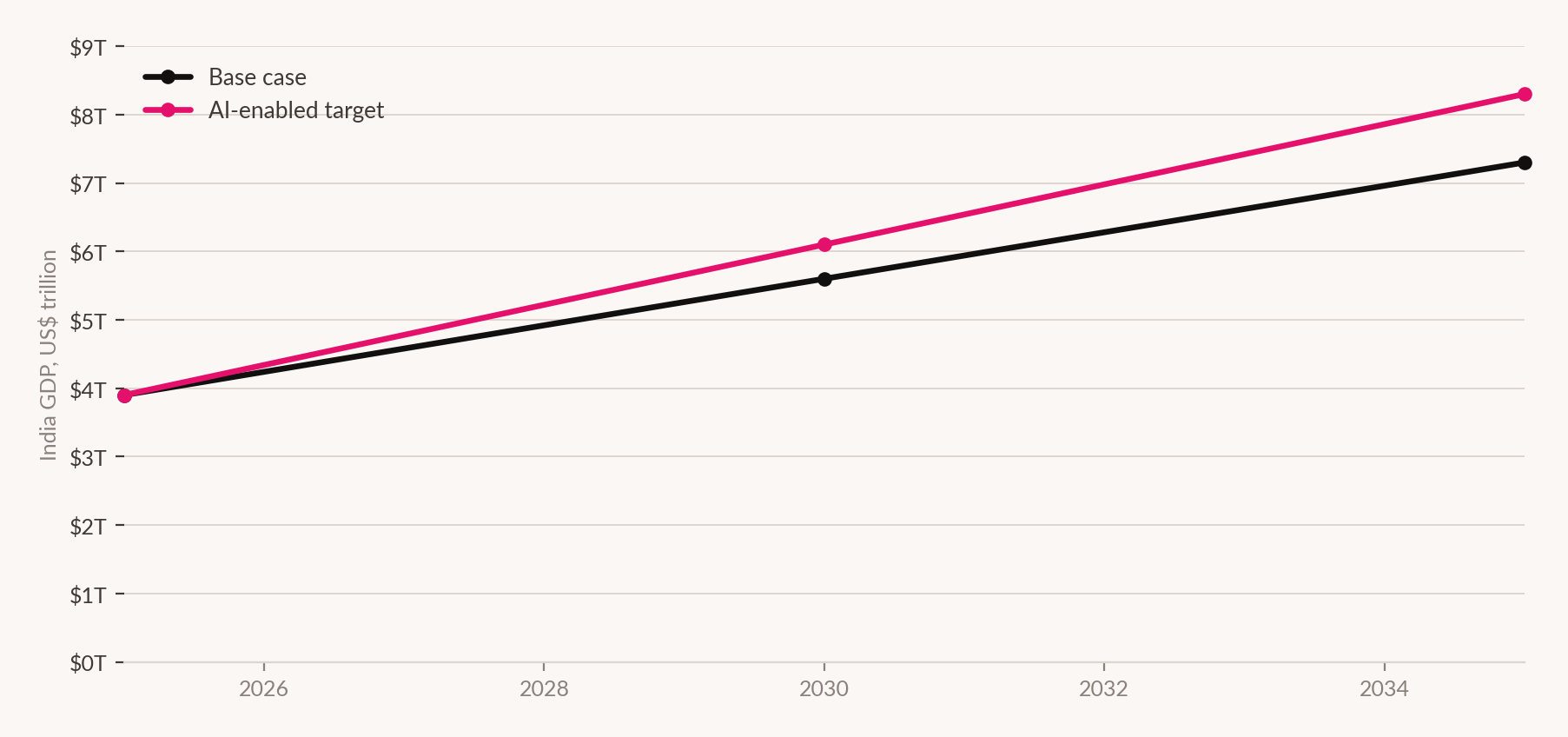
The claim attached to this is that AI, deployed systematically across sectors, can add 1.0 to 1.5 percentage points of annual GDP growth - against a required step-up of 1.4 points.
Treat that as a directional argument rather than a forecast. Economy-wide technology contribution estimates carry very wide error bars and depend entirely on deployment assumptions. What makes it more credible in India's case than it would be elsewhere is the distribution layer: Aadhaar, UPI and the Account Aggregator framework already exist. The rails for delivering AI-enabled services at population scale are built and in production, which removes the constraint that usually makes these projections fail.
| Measure | Figure | Context |
|---|---|---|
| Builders | ||
| Top-100 AI companies with Indian co-founder | 20 | India #1 globally in AI skill penetration |
| Of those, domiciled in India | 1 | The other 19 are elsewhere |
| Capital | ||
| India AI funding, 2024 | $627M | - |
| India AI funding, 2025 | ~2× | Roughly $1.2–1.4bn |
| Vertical AI growth | 2.5× | Now 37% of the funding mix |
| Compute | ||
| Installed GPU base today | 216K | - |
| GPU base required by 2030 | ~3.3M | 15× increase |
| AI power demand by 2030 | ~7 GW | ~30× current levels |
| Hyperscaler commitment | $65bn | Leaves a residual sovereign gap |
| Sovereign AI commitment | $200bn | Stated |
| Enterprise | ||
| Enforcers - mandate without muscle | 26% | 19% of them measure no value at all |
| Transformers - mandate with muscle | 19% | 94% realise value beyond productivity |
| Democratizers | 29% | Scaled bottom-up |
| Tinkerers | 26% | 9% of software budget on AI |
| Early adopters still scaling pilots | 46% | 5% have not started |
| Macro | ||
| GDP today | $3.9T | 6.4% trajectory |
| 2035 target | $8.3T | Requires 7.8% sustained |
| The gap | $1T | AI claimed to contribute 1.0–1.5pp annually |
What follows
If you are an Enforcer, stop enforcing. A quarter of Indian enterprises are running top-down AI programmes without the underlying adoption to execute them, and the documented path out runs through bottom-up experimentation, not through a firmer mandate. This is the single most actionable finding in the study and it costs nothing to act on.
Measure value or accept that you cannot claim it. Nineteen per cent of Enforcers cannot demonstrate any value from AI. That is not a technology failure, it is an instrumentation failure - and it is the reason those programmes will lose budget in the next planning cycle regardless of whether they were working.
For investors: the vertical AI signal is the real one. Vertical AI growing 2.5× to 37% of the funding mix says Indian AI capital is flowing toward applied, industry-specific problems rather than foundation-model competition. Given the compute constraint, that is the rational allocation - India cannot currently out-train the US, and it does not need to in order to build defensible applied businesses.
For policy: the gigawatts matter more than the GPUs. A fifteenfold GPU increase is a procurement challenge. A thirtyfold power increase is a decade-long generation and transmission programme that must begin before the chips are ordered. Any AI infrastructure plan that leads with chip counts and treats energy as an implementation detail has the dependency backwards.
For founders: the domicile question is now a compute question. Nineteen of twenty Indian-founded top-100 AI companies incorporated elsewhere. Capital availability explains part of it; access to compute at competitive cost explains more. Whether that changes depends less on incentives for founders than on whether the 7 GW gets built.
How we did this
What this doesn't prove
- That AI will add 1.0–1.5 points to Indian GDP growth. This is a projection with very wide error bars, dependent entirely on deployment assumptions. We report it as the source's claim and explicitly decline to treat it as a forecast.
- Why 19 of 20 Indian-founded AI companies are domiciled elsewhere. We offer capital and compute access as explanations. Regulatory environment, customer proximity, talent visas and exit market depth are equally plausible and not separable in this data.
- That bottom-up adoption causes Transformer status. The source states the path runs bottom-up first. This is drawn from cross-sectional survey data, not longitudinal tracking, so the direction of causation is inferred rather than demonstrated.
- Whether the 7 GW is achievable. We argue power is the binding constraint rather than chips. We have not modelled Indian generation capacity, grid expansion timelines or land availability, and the source does not either in the material we accessed.
- Anything about model capability or research output. This feature covers compute, capital, enterprise adoption and founder domicile. It says nothing about the quality of AI research being produced in India.
- How much of the $200bn sovereign commitment is deployed. It is a stated commitment. Commitment and deployment are different things and the study summary does not distinguish them.
Sources for this feature
- Zinnov, OpenAI and Z47, The India AI Adoption Edge 2026, 13 May 2026. zinnov.com Straight from the source - primary study, co-authored by interested parties
- Feature 06 of this edition, The 76th-place superpower, for the demand-side picture. Another feature in this edition