
On 10 December 2025, Australia's Online Safety Amendment (Social Media Minimum Age) Act 2024 came into effect, requiring platforms to take "reasonable steps" to prevent under-16s from creating and keeping social media accounts.1 It is the first law of its kind anywhere.
By mid-January 2026, the Australian Government announced that more than 4.7 million accounts judged to be held by under-16s had been deactivated, removed or restricted.1
On 31 March 2026, the eSafety Commissioner opened formal investigations into five major platforms for suspected breaches. The evidence cited as central: approximately 70% of under-16s were still reported by parents to be accessing social media.2
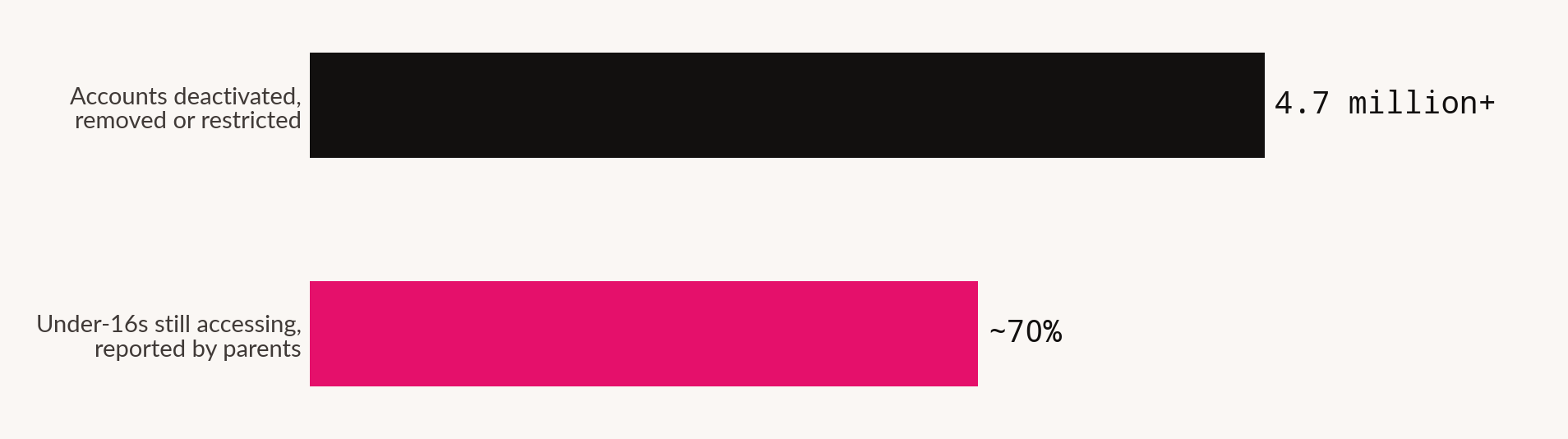
Four point seven million accounts were removed and roughly seven in ten of the people they belonged to are still there. Removing an account is not the same as removing access.
Why both numbers are true
There is no contradiction here, and the reason matters more than the apparent conflict.
An account is an artefact a platform controls. It can be identified, flagged and deactivated at scale, and the resulting number is countable, reportable and genuinely large.
Access is a behaviour a person controls. A deactivated account can be replaced with a new one, an older sibling's, a falsified date of birth, a VPN, a browser rather than an app, or a parent's device. Each of those is trivial individually, and collectively they mean the relationship between accounts removed and children excluded is far weaker than a headline implies.
The law asked for "reasonable steps". Platforms took steps that were reasonable, measurable and reportable. The steps did not produce the outcome, and the regulator's response has been to investigate whether the steps were reasonable enough - which is the only lever the drafting provides.
A dozen countries are watching this specific gap
Australia was always going to be a test case, and the legislation being drafted elsewhere is already diverging from its approach in ways that suggest the gap has been noticed.
Portugal's parliament approved a bill on 12 February requiring explicit parental consent for 13-to-16-year-olds, with fines up to 2% of global revenue for platforms that ignore it.3 Poland is preparing legislation for under-15s that places age verification responsibility on platforms. Slovenia is drafting for under-15s, Spain for under-16s with mandatory age verification, Austria up to 14, and Malaysia for under-16s from 2026.3
More than a dozen countries - including Indonesia, Canada, the UAE, France and the UK - are at some stage of the same journey.3
Note the divergence in Portugal's design. It regulates through parental consent and a revenue-linked penalty rather than through prohibition and "reasonable steps". That is a different theory of enforcement: rather than asking platforms to try harder, it makes non-compliance expensive enough to change the calculation.
Whether that works better is unknown and will be for some years. But it is a response to a visible problem with the Australian model, arriving within three months of that model's first compliance data.
What this is not
This is a research feature on a market and enforcement question, and it is not legal advice. Obligations differ by jurisdiction, several of the laws described here are drafts, and Australia's own regulatory guidance was still developing when we wrote this. We take no position on whether age restrictions are good policy - that is a question about child welfare on which this desk has no standing and no data. The finding here is about the distance between an enforcement metric and an outcome.
What this means for anyone with a social audience
The commercial consequence is not the ban itself. It is what the ban does to the reliability of the audience data underneath every social plan.
If 4.7 million accounts were removed and 70% of the cohort is still present, then a meaningful share of that cohort is now operating under inaccurate declared ages. A 15-year-old who re-registered as 17 is, to every targeting system, a 17-year-old.
That degrades audience data in a specific direction. It does not remove young users from platforms; it removes the platforms' ability to identify them. Age-based targeting, age-based exclusion and age-reported reach figures all become less reliable in the affected markets - and the effect is largest exactly where regulation is strictest.
A regulation designed to remove under-16s from social platforms may instead have removed the platforms' knowledge of which users are under 16.
We want to be careful: this is an inference, not a measurement. No data we found quantifies age misreporting before or after the ban. It follows from the two official figures and the mechanisms in Figure 02, and it is the second-order effect we would most want tested.
What to do about it
Treat age-declared targeting in regulated markets as degraded. Not unusable - degraded, in an unmeasured amount, in one direction. Any campaign relying on age exclusion for brand-safety or compliance reasons needs a second control.
Do not read account removals as audience loss. A platform reporting large under-16 account actions in Australia has not necessarily lost that audience. The reported 70% access rate says most of it is still reachable, under different identifiers.
Watch Portugal's model, not Australia's. Revenue-linked penalties with parental consent is a materially different enforcement theory, and it is the one most likely to be copied if the "reasonable steps" approach continues producing this gap.
Assume the cascade continues. A dozen-plus countries are drafting. For any brand with a young audience across multiple markets, fragmented age rules are now a planning constraint rather than a future risk.
Separate compliance reporting from effect measurement. This is the general lesson and it applies well beyond age regulation: a countable enforcement output is not evidence of a behavioural outcome, and organisations reporting the first as though it were the second will keep being surprised.
| Element | Position |
|---|---|
| Australia | |
| Act in force | 10 December 2025 - Online Safety Amendment (Social Media Minimum Age) Act 2024 |
| Obligation | "Reasonable steps" to prevent under-16s creating and keeping accounts |
| Accounts acted on, to mid-January 2026 | 4.7 million+ |
| Under-16s still accessing, parent-reported | ~70% |
| Formal investigations opened | 31 March 2026, five major platforms |
| Elsewhere | |
| Portugal | Bill approved 12 February - parental consent 13–16, fines to 2% of global revenue |
| Poland | Preparing legislation, under 15, platform-side verification |
| Slovenia | Drafting, under 15 |
| Spain | Announced, under 16, mandatory age verification |
| Austria | Announced, up to 14 |
| Malaysia | From 2026, under 16 |
| Others at earlier stages | Indonesia, Canada, UAE, France, UK and more |
| Not established | |
| Method behind the 70% figure | Parent-reported; survey method not obtained |
| Rate of age misreporting | No data |
| Outcome of the five investigations | Open |
How we did this
What this doesn't prove
- That the law has failed. Five weeks of data and one parent-reported access figure. Behaviour change of this kind is usually measured over years, and 4.7 million account actions is not nothing.
- The reliability of the 70% figure. Parent-reported, method unavailable. Parents may systematically under- or over-report their children's access.
- That age misreporting increased. This is our inference from the two figures and the circumvention routes. No before-and-after data exists.
- Whether Portugal's model works better. It is a different enforcement theory. It has no results.
- Anything about welfare outcomes. The entire policy rationale concerns child wellbeing, and nothing in this feature addresses whether the law helps or harms it.
- That the announced laws will pass. Several are drafts and may change substantially or fail.
Sources for this feature
- Australia's Social Media Minimum Age Act - implementation, guidance and account figures, 2026. privacymatters.dlapiper.com, esafety.gov.au A named study, reported by someone else - legal analysis and regulator
- Enforcement investigations and compliance data, 2026. missionmedia.asia, cnbc.com A named study, reported by someone else - trade and news reporting
- Comparative child social media regulation, 2026. cepa.org, ddnews.gov.in A named study, reported by someone else - policy mapping