
The structural fact about social commerce is not that it is large. It is who is selling.
42% of US TikTok Shop GMV is driven by affiliates, through a marketplace connecting brands with more than two million creators on performance-based terms.1
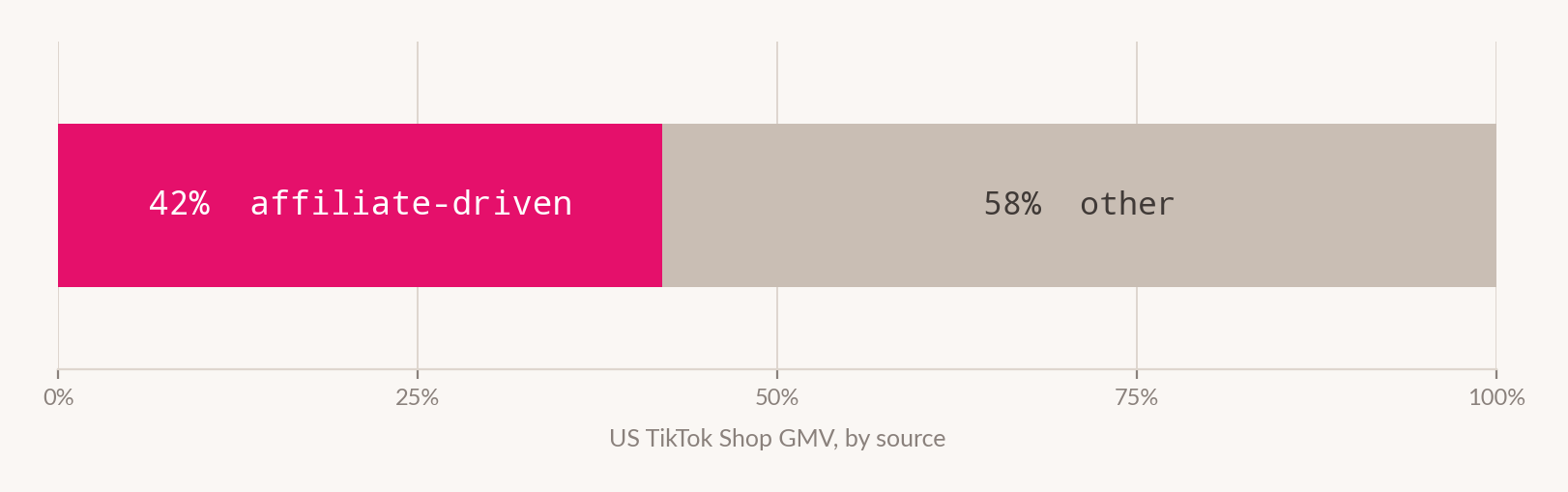
The creator side is growing faster than the platform. TikTok Shop creator earners grew 146% year over year, and more than 16,000 creators now generate six-figure sales.1
Two-fifths of a $27bn projected market moves through people who are paid only if it sells. That is not a media channel. It is a distributed sales force with no fixed cost.
Why commission changes the economics
Advertising and affiliate commission are both ways of paying for demand, and they allocate risk in opposite directions.
The right-hand column explains the 42% better than any argument about creator authenticity. A brand can enrol two million potential sellers at no fixed cost, and the ones who fail cost nothing. Under an advertising model, testing two million distribution partners is inconceivable. Under commission it is the default state.
What it costs the creator
The same property that makes this attractive to brands makes it precarious for the people doing the selling, and the distribution figures show it clearly.
More than two million creators in the marketplace. 16,000 generating six-figure sales. That is roughly eight in every thousand - and note carefully that six-figure sales is not six-figure income. A creator generating $100,000 in merchandise value at a typical commission rate earns a fraction of it, before their own costs.
This is the standard shape of a creator economy and Feature 11 of this desk found the same pattern from the other direction: micro and nano creators taking 45.5% of influencer marketing spend while the returns concentrate at the top. A very large number of participants, a very small number of meaningful earners, and a distribution that rewards the platform regardless of which individuals succeed.
We are not making a moral argument about it. We are noting that a brand planning affiliate distribution should understand that the model's zero-downside property for them is the same mechanism that makes the median participant's outcome negligible - and that a programme dependent on creator enthusiasm needs to account for churn among people who are not being paid.
The measurement advantage nobody mentions
There is a quieter reason affiliate commerce is growing this fast, and it connects directly to the Ads desk.
Feature 01 of that desk documents the gap between what a platform reports and what a business books. Feature 08 sets out why Chinese platforms never had an attribution problem: content and commerce on one surface means the system observes the impression and the purchase.
Affiliate commerce on a native-checkout platform has that property by construction. The attribution question that consumes most of a marketing team's analytical effort simply does not arise - a sale is credited to a creator link, the platform observes both ends, and the commission is calculated on a completed transaction rather than an inferred contribution.
For a brand that has spent a decade arguing about attribution models, a channel where the argument is structurally unnecessary is worth more than the conversion rate alone suggests.
Whose interest this serves
Every figure here comes from social commerce benchmark compilations published by agencies, seller tools and platform partners. A finding that affiliate creator commerce is large and growing is commercially useful to all of them, and the creator-success figures in particular are the kind a platform has an obvious interest in circulating. The 16,000-of-two-million ratio cuts the other way, which is part of why we compute and report it. Marketing Legendary operates a social practice and benefits from the category's growth.
What to do about it
Model affiliate as variable cost of sale, not as marketing spend. It sits in a different line, behaves differently under pressure, and comparing its cost against a CPM is a category error.
Set the commission rate as a pricing decision. It determines how many of the two million creators find you worth their time, and it is the only lever you control in that marketplace. Most brands set it once by copying a competitor.
Expect the distribution, not the average. A handful of creators will produce most of your affiliate volume. Planning against an average creator's output will overstate breadth and understate concentration.
Decide your claim tolerance before you enrol. You are not writing the message. For regulated categories, or any brand with strict substantiation requirements, the zero-downside property is not actually zero - it is deferred into compliance risk.
Use the attribution cleanliness deliberately. This is one of very few channels where the sale is observed rather than inferred. That makes it a useful control against which to sanity-check the channels where it is not.
| Measure | Value | Grade |
|---|---|---|
| Share and scale | ||
| US TikTok Shop GMV driven by affiliates | 42% | Reported |
| Creators in the marketplace | 2m+ | Reported |
| Creator earner growth, year over year | +146% | Reported |
| Creators at six-figure sales | 16,000+ | Reported |
| Share of marketplace at six-figure sales | ~0.8% | Our arithmetic |
| Context | ||
| Micro and nano share of influencer spend | 45.5% | Feature 11 |
| TikTok Shop conversion rate | 4.7% | Feature 40 |
| Not established | ||
| Composition of the other 58% | - | Not stated |
| Typical commission rates | - | Not published |
| Creator earnings, as distinct from sales | - | Not published |
| Creator churn | - | No data |
How we did this
What this doesn't prove
- What creators actually earn. Commission rates are not published. Sales figures tell you nothing about income.
- Whether 16,000 of two million is unusual. We report the ratio. Without comparable figures from other creator marketplaces it has no benchmark.
- That affiliate outperforms advertising. Different risk profiles and different control. No source compares outcomes.
- The composition of the remaining 58%. Unstated, and we decline to allocate it.
- Whether the enrolled-creator figure means active creators. Two million enrolled and two million active are very different denominators.
- Anything outside the US, or outside TikTok Shop. Both the 42% and the marketplace figures are platform- and market-specific.
Sources for this feature
- TikTok Shop affiliate and creator marketplace data, 2026. branvas.com, amraandelma.com, digitalapplied.com From a company that sells into this market - agency and platform-partner compilations
- Features 11 and 40 of this desk, and Features 01 and 08 of the Ads desk. Another feature in this edition