
Three jurisdictions have now forced open the same market. Each arrived at a structurally different remedy, and each produced a different number.
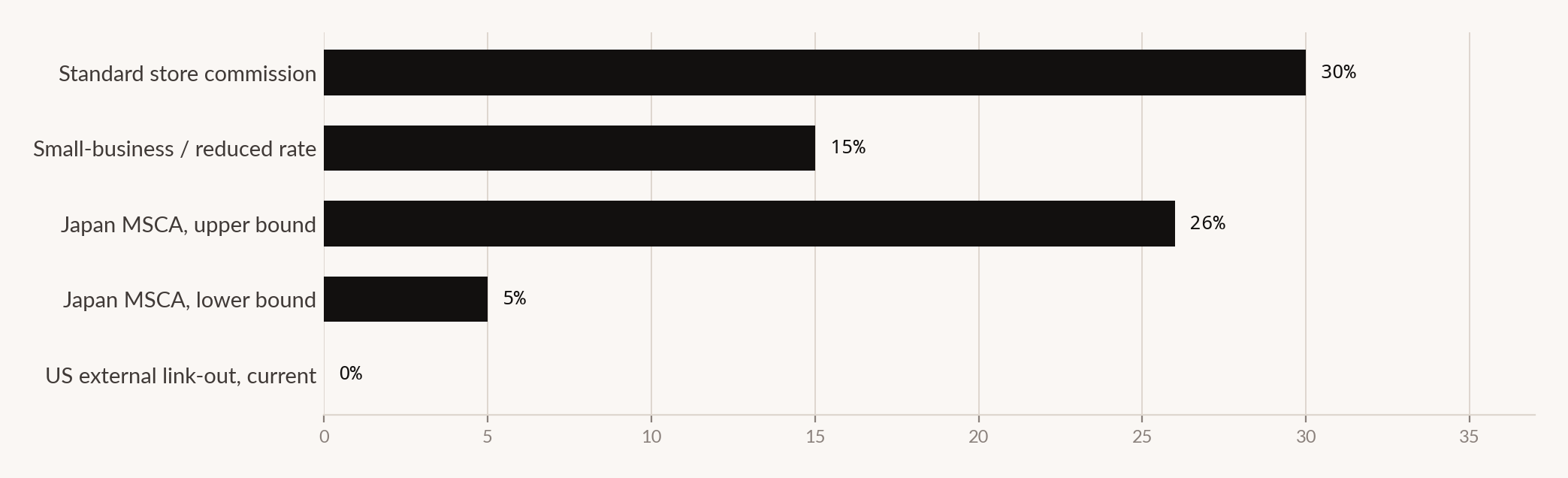
Japan set a published fee schedule: 5% to 26%, depending on how the app is distributed and how it is paid for.1 The European Union wrote conduct rules and is still arguing about compliance. A United States court set the commission on qualifying external purchase links at zero, and the Supreme Court has agreed to hear the appeal.2
What Japan actually legislated
The Mobile Software Competition Act came into force on 18 December 2025. The Japan Fair Trade Commission had designated Apple and Google in March 2025, naming their operating systems, app stores, browsers and search engines as specified software subject to the Act.1,3
The Act prohibits blocking alternative app marketplaces, blocking alternative in-app payment systems, anti-steering restrictions, and blocking alternative browser engines. It also bars self-preferencing in search results, delaying approvals for rival products, and using operating system or store data to advantage the platform's own services.3
Apple's compliance, announced the same week, is specific enough to plan against:1
- Apps may be distributed through alternative marketplaces, and a user may set an alternative marketplace as their default
- Developers may process their own payments in-app, or link out to the web - but must offer Apple's in-app purchase alongside
- Developers may charge lower prices through alternative payment methods
- Fees range from 5% to 26% by distribution and payment method
- Browser and search engine choice screens at device setup; the side button becomes reassignable to third-party voice assistants; users may select a different navigation app
Apple stated its disagreement plainly, saying the requirements for alternative marketplaces and payments open new avenues for malware, fraud, scams and privacy risk.1 It then shipped them. An alternative marketplace was live in Japan within a day.1
Three theories of how to fix a market
The instrument shapes the outcome in a way that is easy to miss.
Japan specified architecture - these distribution paths must exist - and the price fell out of it as a published schedule. A developer in Tokyo can model 5% to 26% against 15% to 30% and decide.
The United States specified a price, through litigation. Zero is a better price than any of Japan's numbers. It is also a price arrived at through a contempt finding, modified once on appeal, currently operative, and now before the Supreme Court.2
The most generous rate in the world is the one you cannot build a five-year plan against.
The European Union specified conduct, ex ante, and got adversarial compliance. The most visible consequence for users has not been cheaper apps - it has been features arriving late or not at all, with iPhone Mirroring still unavailable in the EU.1
The comparison Apple made, and why it is worth noting
Apple has been explicit that it regards Japan's regime as better designed than the EU's: clearer on privacy, security, safety and youth protection, and more respectful of its intellectual property.1 Apps distributed outside the App Store in Japan still require age ratings; in the EU they do not.1
That is a self-interested comparison from a regulated party, and should be read as one. It is also a testable claim about regulatory design rather than a complaint about being regulated - Japan's remedy is in several respects more intrusive than the EU's on distribution, and Apple prefers it. The variable is not how much a regime demands. It is how precisely it says so.
| Dimension | Japan | European Union | United States |
|---|---|---|---|
| Instrument | Statute (MSCA) | Regulation (DMA) | Court injunction |
| Live since | 18 December 2025 | Phased from 2024 | Remedy operative during appeal |
| Alternative marketplaces | Required; may be set as default | Required | Not required |
| Web distribution | Not required | Required | Not required |
| Alternative in-app payment | Permitted, alongside Apple IAP | Permitted | Not addressed by the remedy |
| External link-outs | Permitted | Permitted | Permitted, unrestricted in style and placement |
| Commission | 5–26% by method | Fee structure contested | Zero on qualifying external purchases |
| Age ratings outside the store | Still required | Not required | Not applicable |
| Choice screens | Browser, search, navigation, side button | Browser, search | None |
| Features withheld by the platform | None reported | Several, including iPhone Mirroring | None reported |
| Stability | Statutory, with published guidelines | Ongoing enforcement disputes | Before the Supreme Court |
What this means for a developer shipping one binary
You now build a single product that behaves differently in three territories, with different payment options, different distribution paths, different rating obligations and three different economics.
Feature 14 of this edition established the outcome to keep in view: in the EU - the most permissive regime available for most of this period - the measurable revenue that actually left App Store billing was in the single digits. Rights were won comprehensively and money moved marginally.
Japan is the first test of whether a clearer regime moves more money. It has been in force since December, and no leakage data exists yet.
What to do about it
Model Japan first, not the United States. Japan's 5–26% is worse than zero and it is published, statutory and unlikely to change next term. If you are going to build alternative payment plumbing once, build it against the number that will still be there.
Do not architect around the US remedy alone. It is operative, it is the best rate available, and it is before the Supreme Court. Build so that the commission rate is a configuration value rather than an assumption in your pricing model.
Price the friction, not the fee. Every one of these remedies except Japan's in-app payment option requires the user to leave your app. The commission you save is worth nothing if the checkout completion rate falls further than the fee.
Budget for territory-specific obligations, not just territory-specific rates. Japan requires age ratings for apps distributed outside the store. That is engineering and review work with no revenue attached to it.
Watch what regulators copy. Japan's Act is the newest of the three and the one Apple has praised. If precision is what produced a workable outcome, the next jurisdiction to legislate will notice - and the terms a developer plans against in 2028 are being drafted now.
How we did this
What this doesn't prove
- That the three rates are comparable. They apply to different transaction types under different conditions in different territories. Placing them on one axis makes the spread legible and the comparison loose.
- The outcome of the Supreme Court appeal. Certiorari was granted. The zero-commission remedy is operative in the meantime, and that is all that can be said.
- That Japan's regime works better. It has been in force since December 2025 and no data on developer uptake, marketplace share or revenue movement exists yet. The claim here is about design clarity, not measured outcome.
- That withheld EU features are caused by the DMA. Apple says they are. That is a contested assertion from an interested party, and no independent finding establishes the causal link.
- Anything about Google's position. Google was designated alongside Apple in Japan and faces its own DMA and litigation obligations. This feature follows the iOS side because the reporting is more complete; that is a limitation, not a judgement.
- What happens to consumers. None of this material addresses whether app prices changed for users in any of the three territories.
Sources for this feature
- John Gruber, Apple Announces Changes to iOS in Japan for Compliance With the Mobile Software Competition Act, Daring Fireball, 20 December 2025, relaying Apple Newsroom, 9to5Mac and MacRumors reporting of 17 December 2025. daringfireball.net · macrumors.com A named study, reported by someone else - platform announcement via named trade press; commentary source, position disclosed
- Apple Wins Ability to Charge Fees on External Payment Links as Appeals Court Modifies Epic Injunction, MacRumors, 11 December 2025; Ninth Circuit Largely Upholds Ruling in Epic v. Apple, Fenwick. fenwick.com A named study, reported by someone else - named law firm and trade press
- Starting Up the Competition: Japan's Mobile Software Act, Center for Strategic and International Studies. csis.org A named study, reported by someone else - policy research institution
- Feature 14 of this edition. Another feature in this edition