
Every technology adoption curve has a shape, and most of them are variations on a rising line. Slow start, steep middle, plateau. Agentic AI in 2026 has produced something less common and more interesting: adoption and confidence moving in opposite directions at the same time.
The adoption side is close to total. 90.3% of marketing teams use AI agents somewhere in their operation. That is not an early-adopter figure; that is saturation.1
The autonomy side is not. Only 23.3% run agents in full production. 80.6% keep them in assist-only mode - the agent proposes, a person disposes.1
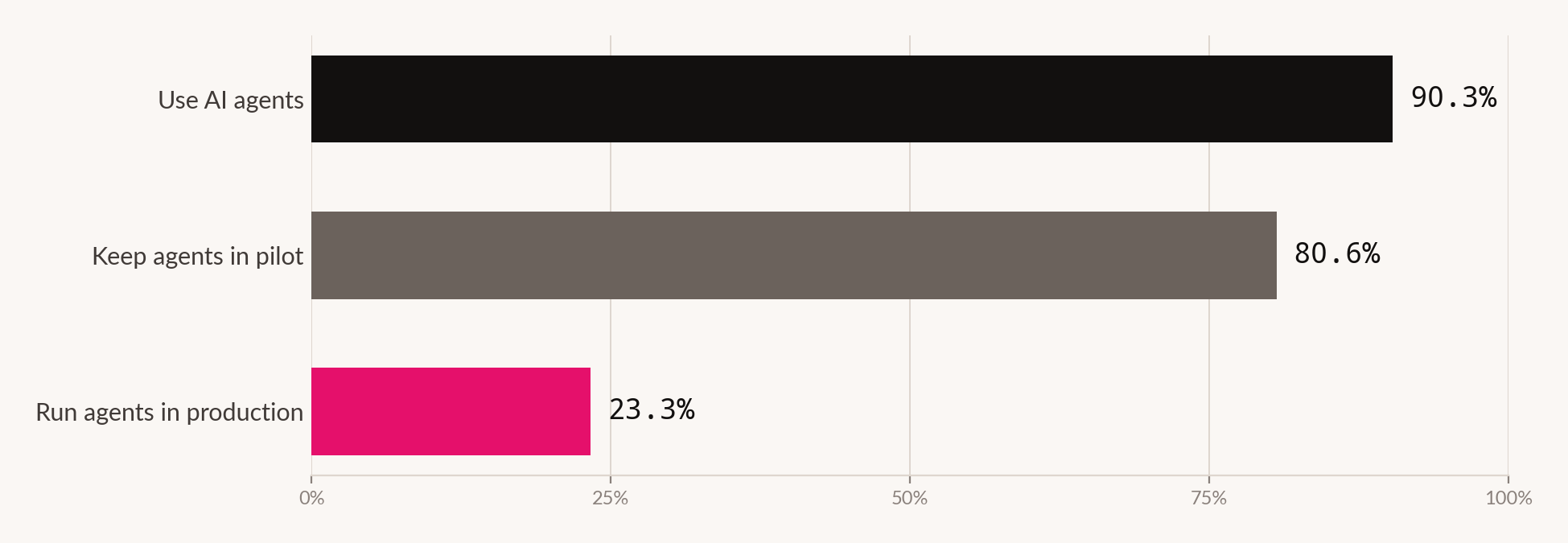
Near-universal adoption alongside near-universal restriction is not indecision. It is a verdict.
Confidence did not fail to arrive. It left.
The single most important number in this feature is a change rather than a level. Confidence in fully autonomous agents fell from 43% to 22% in one year, as organisations encountered reliability issues in production.2
This distinction matters more than it might appear. A technology that has not yet earned confidence and a technology that has lost confidence are at very different points, and the second is considerably harder to recover from.
The 43% figure represents a period when most organisations were reasoning about autonomous agents from demonstrations, vendor material and pilots. The 22% figure represents a period when a large number of them had run agents against real systems, real data and real customers.
Confidence halved on contact with production.
Where agents die
IDC finds that 88% of AI proofs-of-concept never reach widescale deployment.2 That figure is worth sitting with, because it means the modal outcome of an agentic AI project is not failure in production - it is never arriving there.
The causes are reported as infrastructure gaps (41%), governance and security barriers (38%) and ROI measurement failures (33%).2 Separately, 46% of organisations cite system integration as their single largest barrier.3
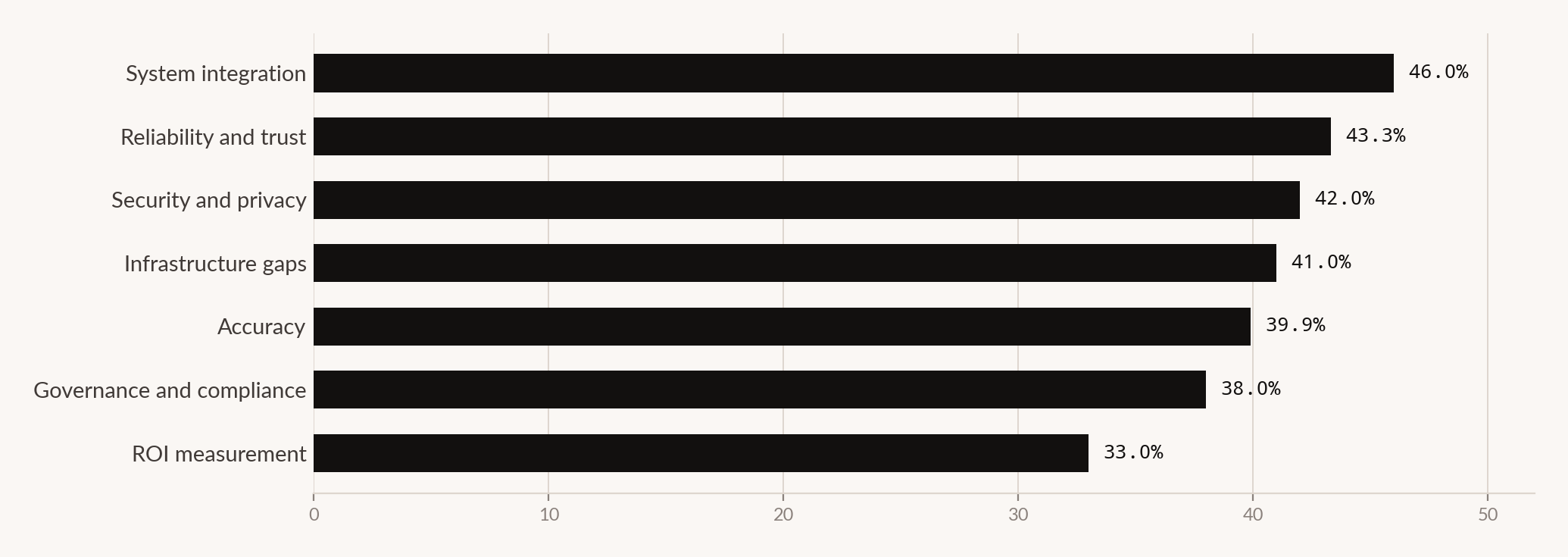
Read the list and notice what is not at the top. The barriers are not "the model is not clever enough". They are integration, reliability, infrastructure and governance - engineering and organisational problems rather than capability problems.
Which connects directly to Feature 09 of this edition. A martech estate at 49% utilisation, fragmented across 15,505 possible products, with data held in tool-specific stores, is precisely an environment in which system integration becomes the top barrier to anything. The agent problem and the data-estate problem are the same problem wearing different labels.
The ROI contradiction, and how it resolves
Set against all of the above sits a figure that appears to contradict it entirely: 80% of companies report positive ROI from their agentic systems.4
The resolution is straightforward once the two questions are read carefully. They are not asking about the same product.
The ROI is real, and it is coming from assist mode. An agent that drafts, summarises, researches, monitors and proposes - with a person approving before anything ships - delivers genuine productivity gain at low risk. That is what 80.6% of teams have deployed, and it is plausibly what the 80% positive-ROI figure is measuring.
The confidence collapse is about autonomy specifically. Not whether agents are useful, but whether they can be trusted to act unsupervised against production systems.
Organisations did not conclude that agents do not work. They concluded that agents work and autonomy does not - and they responded rationally by keeping the capability and withdrawing the permission.
This is the same shape as Feature 02
Readers of this edition will recognise the pattern. Feature 02 documented Meta's Advantage+ Shopping falling from 38% to 20% of retail spend in twelve months while Performance Max held at 67% of Google Shopping spend - and the resolution there was that advertisers who acquired the ability to test discovered that automated campaigns reported better than they performed.
The mechanism is identical: automation is adopted on the vendor's claim and reined in on the operator's evidence. In ad platforms it took the form of budget share moving back to manual. In enterprise agents it takes the form of production access being withheld.
In both cases the trigger was not a failure of the technology in the abstract. It was the arrival of measurement.
The governance vacuum
One finding deserves isolating because it describes a risk that is currently unpriced. Among organisations with genuine agentic deployments, 53.1% lack agent-specific governance policies.2
More than half of the organisations that have put software agents into production against real systems have not written rules specific to what those agents may do.
Existing policy frameworks were written for humans and for deterministic software. An agent is neither. It takes actions a human did not individually authorise, using judgement that cannot be fully specified in advance, at a speed and volume no reviewer can sample meaningfully.
The 53.1% figure and the 22% confidence figure are probably related in a way that is not flattering to either: it is difficult to be confident in a system you have not defined rules for, and difficult to write rules for a system you were not confident enough to design carefully.
What happens next
Two forecasts sit in tension and both are worth holding.
On one side: 40% of enterprise applications will feature task-specific AI agents by the end of 2026, up from less than 5% in 2025.4 Agents are being embedded into software the organisation already owns, which removes the integration barrier that currently kills projects - because the vendor solves it rather than the customer.
On the other: Gartner predicts 40% of agentic AI projects will be cancelled by the end of 2027.4
These are not contradictory. The most probable reading is that bespoke agentic projects get cancelled at high rates while embedded, task-specific agents proliferate - the same pattern the martech market has just been through, where horizontal capability delivered inside existing tools displaced standalone builds.
If that holds, the winning posture is not to build an agent platform. It is to be ready to use the agents that arrive inside the software you already have - which is a data-readiness problem, not an AI problem.
A definitional conflict we could not resolve
Two credible-looking figures describe agent production deployment very differently. One reports 23.3% of marketing teams running agents in full production. Another reports 51.3% of respondents claiming agents in live production, with about 23% actually scaling them.
The likeliest explanation is definitional: "in live production" and "in full production" and "scaling" are three different bars, and the ~23% figure appears in two independent studies as the share doing the harder version.
We use 23.3% because it is the marketing-specific figure and because the ~23% level is corroborated across sources. A reader modelling this should treat "genuine production autonomy" as roughly a quarter of organisations and "some agent in some pipeline" as much higher.
| Measure | Figure | Note |
|---|---|---|
| Adoption | ||
| Marketing teams using AI agents somewhere | 90.3% | Effectively saturated |
| Keeping agents assist-only | 80.6% | Human in the loop |
| Running agents in full production | 23.3% | See definitional note |
| Organisations scaling agents | ~23% | Corroborates the above |
| Confidence | ||
| Confidence in fully autonomous agents, prior year | 43% | - |
| Confidence, 2026 | 22% | Halved in twelve months |
| Failure | ||
| AI proofs-of-concept never reaching wide deployment | 88% | IDC |
| Top barrier - system integration | 46% | - |
| Reliability and hallucinations | 43.3% | - |
| Security and privacy | 42.0% | - |
| Lacking agent-specific governance | 53.1% | Among those with live deployments |
| Outcome and forecast | ||
| Reporting positive ROI from agentic systems | 80% | Most plausibly from assist mode |
| Enterprise apps with task-specific agents by end 2026 | 40% | From under 5% in 2025 |
| Agentic projects forecast cancelled by end 2027 | 40% | Gartner |
What to do about it
Stop treating assist-mode as a waypoint. The implicit plan in most organisations is that agents graduate from assist to autonomous once trust is earned. The confidence data suggests trust is moving the other way. Assist mode is where the demonstrated ROI is; design for it as a destination rather than a phase.
Write agent-specific governance before you need it. With 53.1% of live deployments lacking it, this is the most common unmanaged risk in the category. The minimum viable version is short: what systems may an agent write to, what actions require human approval, what is logged, and who is accountable when it acts wrongly.
Solve integration before capability. System integration is the top-cited barrier at 46%, and infrastructure gaps kill 41% of projects. Neither is fixed by a better model. Both are fixed by the data consolidation described in Feature 09 - which means the martech clean-up and the agent programme are one initiative, not two.
Assume the agent will arrive embedded. With 40% of enterprise applications expected to ship task-specific agents by end of year, and 40% of bespoke agentic projects forecast for cancellation, the base rates favour waiting for your existing vendors over building. The exception is where the agent would operate on proprietary data that constitutes actual advantage - Feature 09's layer three.
Measure the agent the way you would measure a hire. The ROI measurement failure that kills 33% of projects is usually an instrumentation problem, not a performance one. If you cannot state what the agent was supposed to change and what it actually changed, the project will lose its budget in the next cycle regardless of whether it worked.
How we did this
What this doesn't prove
- That autonomous agents do not work. Confidence falling is evidence about organisational belief, not about capability. A 22% confidence level is consistent with agents working well in narrow, well-instrumented domains and poorly in broad ones.
- That the confidence decline is permanent. One year-on-year movement is a short series. It could reflect a trough following inflated expectations rather than a settled verdict.
- What the 80% positive-ROI figure is measuring. Our assist-mode explanation is an inference. The source does not segment ROI by deployment mode, and self-reported ROI is a weak instrument in any case.
- That the 88% PoC failure rate is agent-specific. IDC's figure covers AI proofs-of-concept generally. Agentic projects are plausibly harder than average, but the figure is not agent-only.
- Anything about which agent products or frameworks perform better. No vendor-level comparison exists in this data and none is offered.
- That embedded agents will succeed where bespoke ones failed. This is the most speculative claim in the feature. It rests on an analogy to martech consolidation and on two forecasts pointing in compatible directions - not on evidence.
Sources for this feature
- Martech adoption statistics 2026 - agent adoption, assist-only and production shares. shno.co From a company that sells into this market - compilation
- Enterprise agentic AI research 2026 - confidence decline, IDC PoC failure rate, governance gap, failure causes. A named study, reported by someone else - named research via secondary coverage
- State of AI Agents 2026 - system integration as top barrier. A named study, reported by someone else
- Agentic AI adoption and market statistics 2026 - ROI, embedded-agent forecast, Gartner cancellation forecast. From a company that sells into this market - compilation
- Features 02 and 09 of this edition. Another feature in this edition