
Take the share figures first, because they are unambiguous and they cut against most of the commentary.
Google holds 89.87% of the conventional search engine market while expanding its own AI capability through Gemini.1 On referrals specifically, Google still sends 87.6%.2
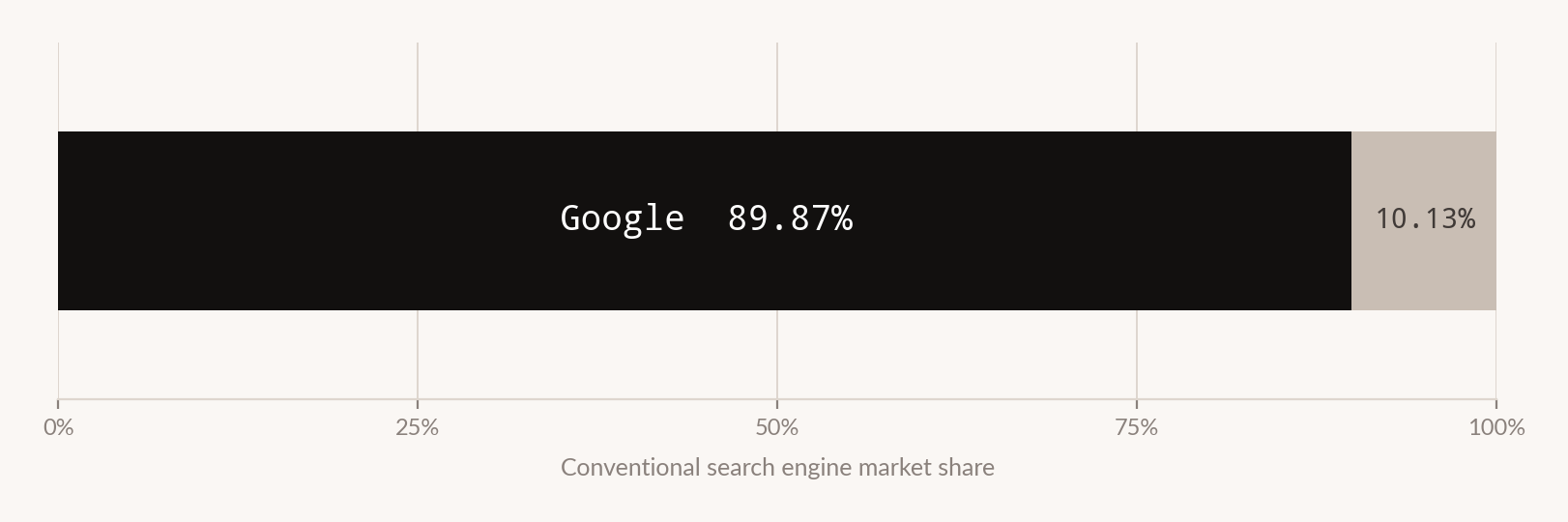
Every argument that Google is losing search has to start by explaining a number that has barely moved.
A second market, with a different leader
The AI chatbot market is a separate board, and Google is not winning it.
ChatGPT holds 64.5 to 68% of AI chatbot market share. Gemini is approximately 15%. Microsoft Copilot approximately 13.2%. The remaining 11% or so is split across Claude, Perplexity, DeepSeek, Grok and others.1
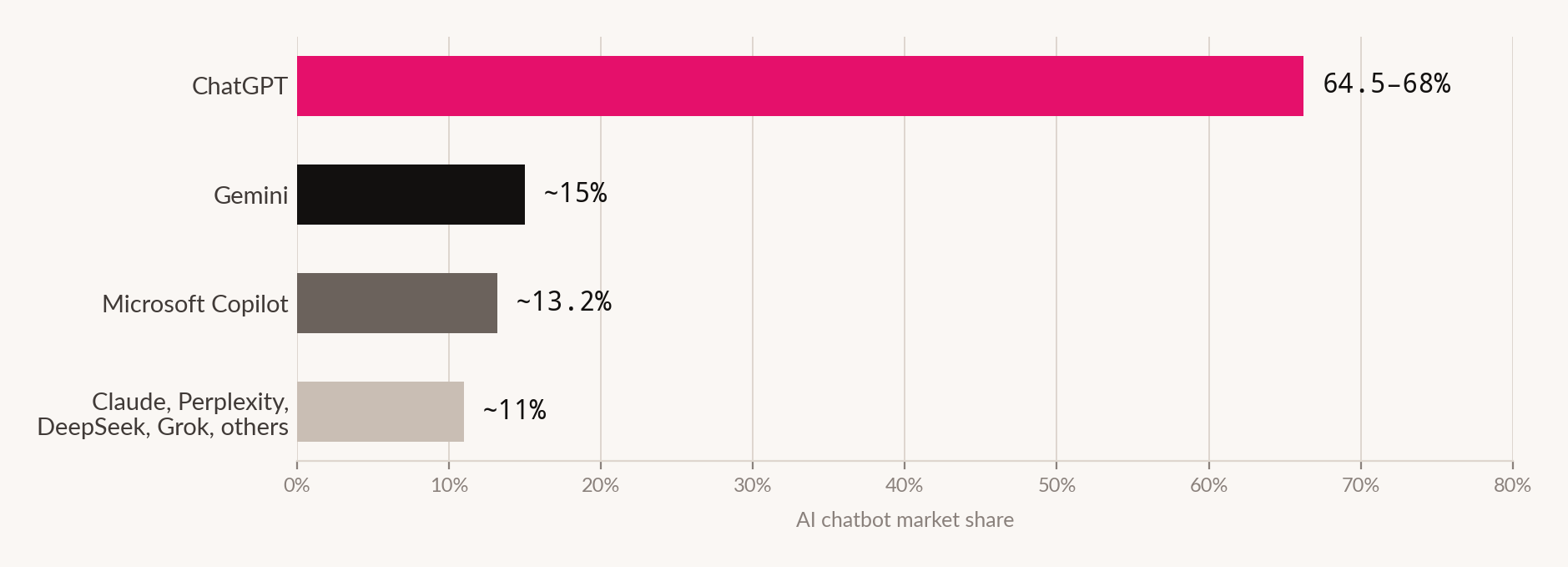
Two markets, two leaders, and a company holding 89.87% of one while holding roughly 15% of the other. That is the actual competitive position, and reporting either half alone produces a misleading picture.
Where it gets interesting: growth
Share is a stock. Growth is a flow, and the flow is pointing somewhere the share numbers do not.
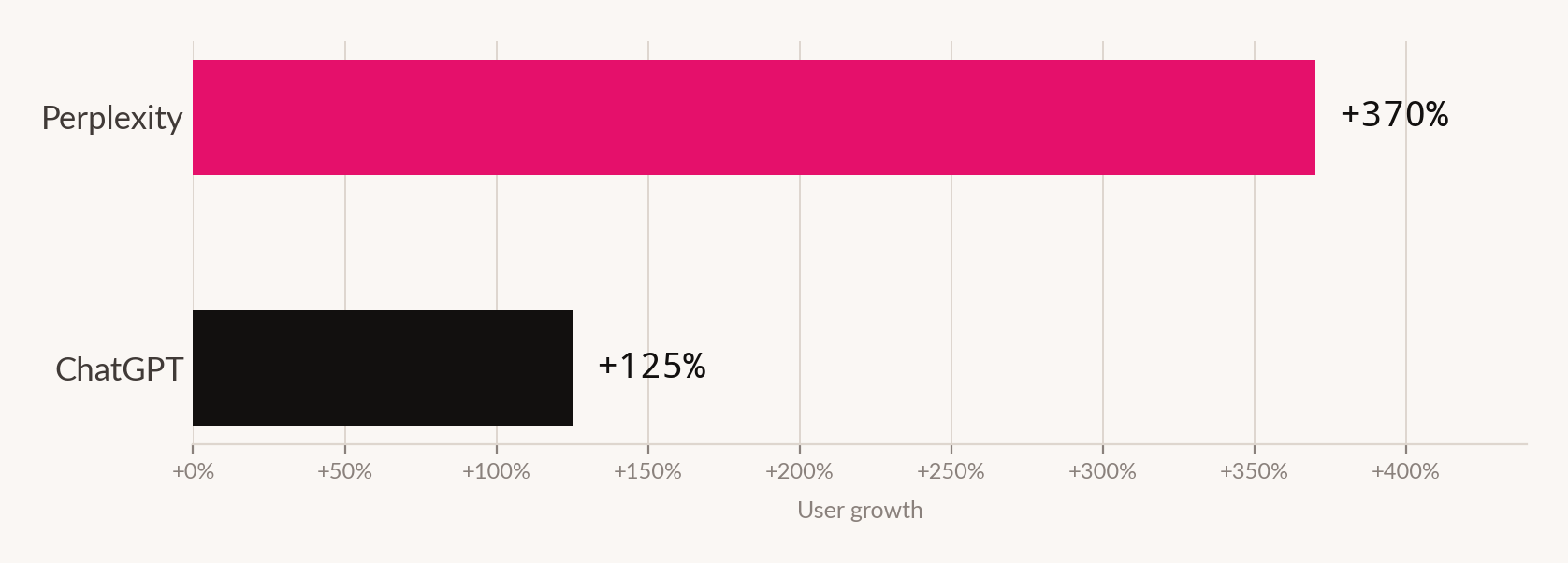
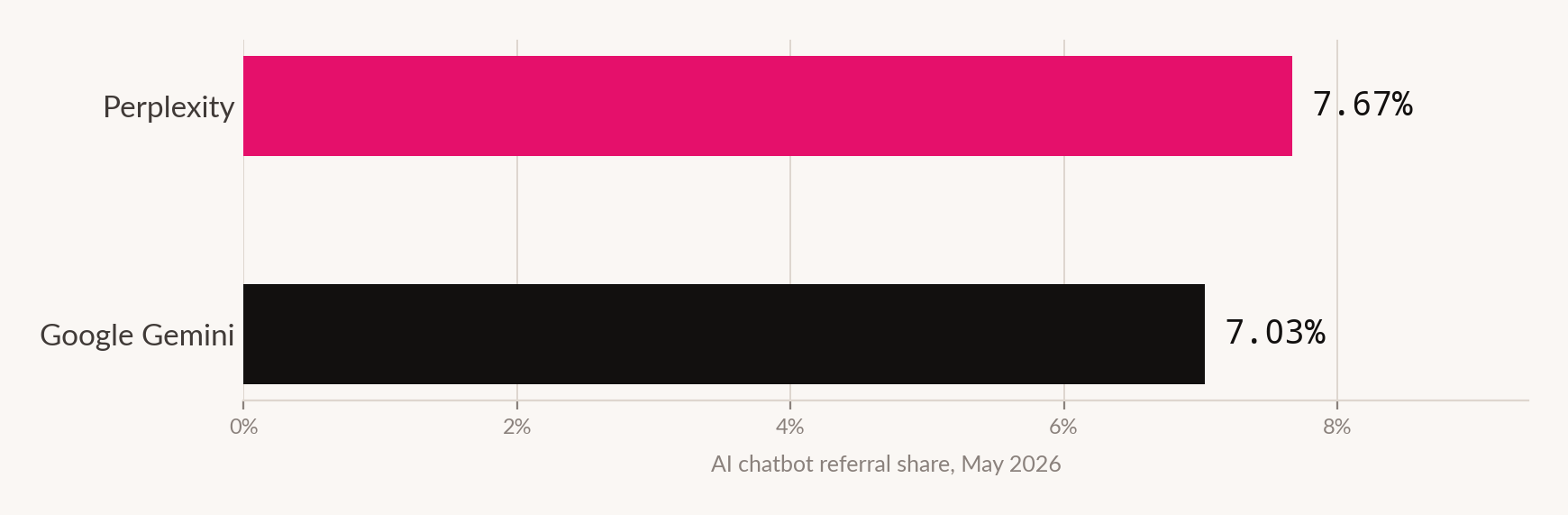
Perplexity grew users 370%. ChatGPT grew 125%.1 And in referral share specifically, Perplexity reached 7.67% by May 2026 - above Google's own Gemini at 7.03%.1
Perplexity is reported at roughly 50 million weekly queries.1 Set against Google's volume that is a rounding error. Set against its own position eighteen months ago it is a different company.
The reading that fits both halves
Share and growth disagree because they answer different questions, and the disagreement is the finding rather than a problem to resolve.
Both columns are true. An organisation reading only the left one concludes nothing has changed and is correct about this quarter. An organisation reading only the right one concludes Google is finished and is wrong by an order of magnitude.
A measurement warning
The figures in this feature come from several trackers using different definitions of "market share" - some measuring users, some queries, some referrals - and we could not obtain the basis for most of them. Comparing a usage share against a referral share is a category error and it happens constantly in this coverage. We have labelled which is which on every figure, and where a number's basis was unclear we have said so rather than assuming.
The number that is not being measured
There is a category of query this data cannot see, and it is the one that matters commercially.
Every figure above counts queries, users or referrals in aggregate. None distinguishes a person idly asking a question from a person evaluating a purchase. A market share of 89.87% across all searches tells you almost nothing about share of the searches that precede a decision - and there is no published breakdown of either market by commercial intent.
This matters because the two systems are plausibly specialising. Conventional search retains transactional and navigational intent, as the Content desk's Feature 21 sets out: a person who wants to buy, book or log in must reach a destination. Answer engines take the explanatory and comparative work that used to sit earlier in the same session.
If that split is real, then a 15% share of AI chatbots could represent a much larger share of pre-purchase research than a 15% share of all queries would imply - or a much smaller one. The direction is not obvious and nobody has measured it.
Share of queries is not share of decisions, and the entire strategic argument turns on a ratio nobody publishes.
The practical consequence is that both the bullish and bearish readings of this data are underdetermined. Anyone asserting confidently that AI search does or does not matter commercially is reasoning from volume figures to revenue conclusions without the bridge.
What to do about it
Report the two markets separately. Conventional search and AI answer engines have different leaders, different share structures and different growth. A single "organic" line collapses them and hides everything useful.
Weight effort by share, hedge by growth. The evidence supports Google receiving most of the effort in 2026 and does not support ignoring the entrants. Those are compatible positions and most plans pick one.
Check whether you are eligible on the growing systems at all. Feature 28 of this desk found 40.9% of top sites unreadable to GPTBot. Growth is irrelevant if your robots.txt excludes you from the systems doing the growing.
Do not read referral share as usage share. A system that answers completely sends fewer referrals while being used more. Perplexity's position above Gemini may reflect linking behaviour rather than popularity, and the distinction changes what you would do about it.
Set a review trigger, not a strategy change. Nominate a threshold - a share level, or two consecutive quarters of a growth rate holding - that would cause you to reallocate. Deciding it now is far cheaper than deciding it in the quarter it happens.
| Measure | Value | Basis |
|---|---|---|
| Conventional search | ||
| Google market share | 89.87% | Market share tracking |
| Google share of referrals | 87.6% | Referral tracking |
| AI chatbots | ||
| ChatGPT | 64.5–68% | Range across sources |
| Gemini | ~15% | Reported |
| Microsoft Copilot | ~13.2% | Reported |
| Claude, Perplexity, DeepSeek, Grok, others | ~11% | Residual |
| Growth and referral | ||
| Perplexity user growth | +370% | Base not disclosed |
| ChatGPT user growth | +125% | Base not disclosed |
| Perplexity referral share, May 2026 | 7.67% | Statcounter |
| Gemini referral share, May 2026 | 7.03% | Statcounter |
| Perplexity weekly queries | ~50m | Reported |
| Not established | ||
| Consistent definition of market share | - | Varies by tracker |
| Base figures behind the growth rates | - | Not disclosed |
How we did this
What this doesn't prove
- That the growth rates will persist. Two points and no base figures. High growth from small bases decays as a rule.
- That Perplexity is more used than Gemini. It has higher referral share. That is a statement about linking behaviour, not popularity.
- That any of these shares are measured comparably. Different trackers, different definitions, mostly undisclosed.
- That AI chatbot share substitutes for search share. They are counted separately and may overlap heavily in the same users.
- Any revenue implication. Share of queries is not share of commercially valuable queries, and no source breaks it down.
- What the antitrust remedies do to this. Feature 27 sets out a syndication remedy that could lower entry barriers substantially. None of these figures anticipates it.
Sources for this feature
- AI search and chatbot market share, growth and referral data, 2026. stackmatix.com, trakkr.ai, presenc.ai From a company that sells into this market - compiled tracking, definitions vary
- Search engine market share and referral tracking, 2026. technologychecker.io A named study, reported by someone else - referral tracking
- Features 27, 28 and 32 of this edition. Another feature in this edition