
The finding is a ratio, and the ratio is the argument.
Across an analysis of more than 25 million links spanning ChatGPT, Claude and Gemini, 84% of AI citations came from earned media. Paid and advertorial content accounted for 0.3%.1
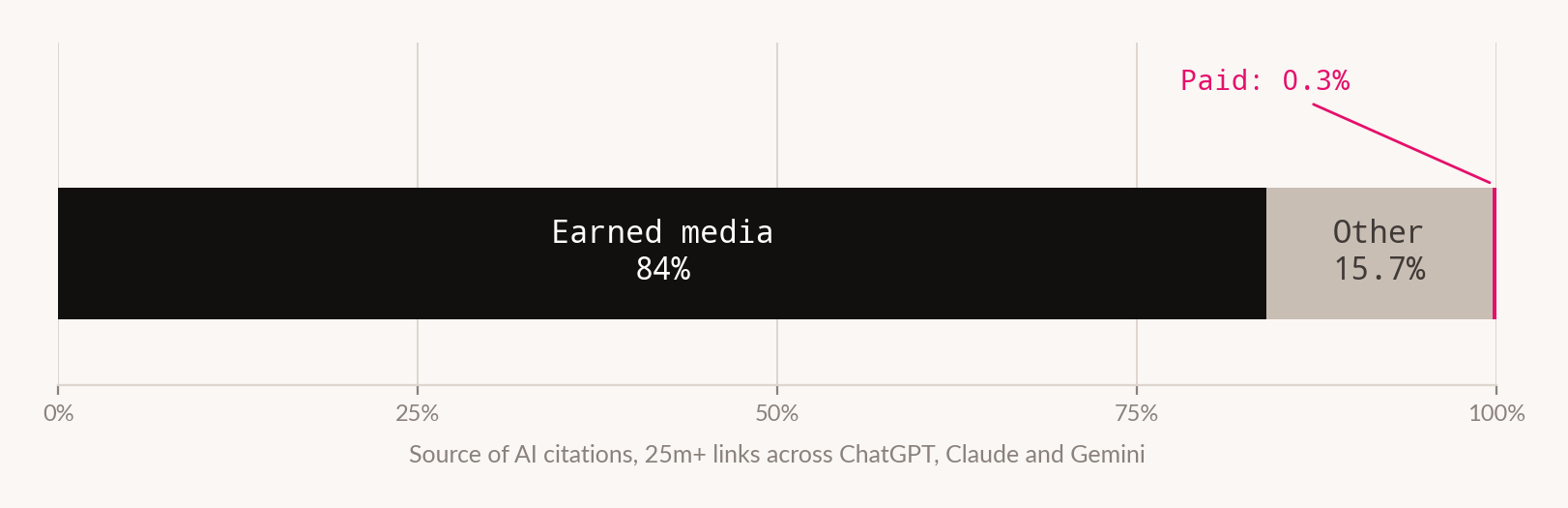
A ratio of 280 to one between earned and paid is not a preference. It is close to an exclusion.
Why this is unlike every previous channel
Every major distribution channel of the last thirty years has had a paid entrance. Search has ads above the organic results. Social has promoted posts in the feed. Display, video, retail media, podcasts - in each case a brand that could not earn attention could purchase equivalent placement, and the purchased version sat in the same visual space as the earned one.
The generated answer does not currently work that way. There is no advertising inventory inside the paragraph. A brand appears in it because the system reached for a source, and the sources it reaches for are overwhelmingly ones somebody else published.
For the first time since search, the dominant discovery channel has no purchasable entrance. You cannot buy your way into a sentence.
We should be careful about permanence here. Commercial pressure on model providers to introduce sponsored placement is obvious and considerable, and several have signalled interest in advertising products. The 0.3% describes the position in 2026, not a law of nature. But it describes the position in the year budgets are being set.
What "earned" means when a machine is doing the reading
The word carries baggage from public relations, and the baggage is misleading. Earned media in the citation context is not principally about press coverage or journalist relationships. It is a broader category: material about you, published somewhere other than your own site, by someone with no commercial obligation to publish it.
That includes trade coverage and analyst notes, but it also includes forum answers, community discussion, documentation written by users, comparison pages built by third parties, and academic or industry references. Coverage of the citation research notes that even where content is not directly cited via a link, models still recognise brand mentions across the web, and that digital public relations, expert commentary and high-authority citations all improve the chance of surfacing.1
The budget implication is awkward
Content marketing now takes 26% of total marketing spend, and 32% of B2B marketers plan to increase investment in owned media - content assets, website, blog, email.2
Owned media is a real asset and Feature 25 of this desk makes the case for part of it. But note the mismatch. The citation economy rewards material published elsewhere, and the budget response to losing search traffic is to invest further in publishing here.
These are not directly comparable figures and we are not claiming they are. One is a share of citations; the other is a share of marketers reporting an intention. Placed together they indicate a possible misallocation, not a proven one.
But the direction is worth sitting with. If the dominant new channel is fed by third-party publication, a content function that responds by producing more first-party publication is optimising the wrong side of the ledger.
Why this is harder than it sounds
Earned coverage cannot be commissioned, which is the whole point of the category and also its operational problem. There is no media plan for it, no rate card, no guaranteed delivery, and no way to scale it by increasing spend.
What can be influenced is the probability. Three mechanisms are visible in the available evidence, and all three are slow.
Whose interest this serves - including ours, unusually directly
The 84/0.3 analysis is published by parties in the earned-media and digital PR business. A finding that earned media dominates AI citation is maximally useful to anyone selling earned media services, and that is exactly who produced it. The scale - 25 million links - is reassuring but the interest is not incidental. Our own conflict is more direct than usual: Marketing Legendary publishes original research and operates a content practice. A feature concluding that original research earns citations is a feature concluding that our business model is correct. Read it with that in view.
The function that inherits this
There is an organisational consequence that follows directly from the ratio, and most companies are not structured for it.
If 84% of citations come from earned media, then the largest share of the new discovery channel is influenced by whichever function owns third-party publication. In most organisations that is public relations or communications - a function that typically sits outside marketing's performance reporting, is measured on coverage volume and sentiment, and has no visibility into search or content metrics at all.
Meanwhile the function being held accountable for organic visibility is content or SEO, which owns the 84%'s smaller counterpart: publication on properties the company controls.
The team being asked to fix organic visibility does not control the channel that now supplies most of it.
This is a structural misallocation of accountability rather than a failure of effort, and it is invisible on any dashboard because the two functions report into different frameworks. A content team can execute perfectly against every metric it owns and lose citation share to a competitor whose PR function happened to place three analyst mentions.
We are describing a mechanism rather than reporting a finding - no research we found examines how organisational structure affects citation outcomes, and we would like to see it tested. But the shape of the problem follows from the 84% figure and the ordinary division of labour in a marketing organisation, and it is worth checking against your own org chart before commissioning more owned content.
What to do about it
Audit your citation base before changing anything. Find where you are currently named in generated answers and, more usefully, which source the system drew on. If the cited page is not yours, that third party is now part of your distribution and you probably do not know their name.
Move budget from production to publication. Not from content to PR wholesale - but a function producing forty owned pieces a quarter and pursuing no third-party publication is aimed at the smaller share of the citation economy.
Publish the data, not the conclusion. A number with a stated method is citable. An opinion is synthesisable from a hundred other opinions and confers nothing. This is the most reliable route into the 84% and it happens to be the hardest.
Treat documentation and community as distribution. They are heavily represented in what models ingest and are usually owned by product or support functions with no visibility into marketing's citation problem.
Watch for the paid entrance opening. The 0.3% is a 2026 observation about systems under commercial pressure to monetise. If sponsored placement arrives inside generated answers, the strategic picture changes quickly - and the organisations that built an earned base will still hold it.
| Measure | Value | Grade |
|---|---|---|
| Citation source mix | ||
| Earned media | 84% | Reported |
| Paid and advertorial | 0.3% | Reported |
| Ratio, earned to paid | 280 : 1 | Our arithmetic |
| Unattributed residual | ~15.7% | Our arithmetic, composition unstated |
| Links analysed | 25m+ | Reported |
| Systems covered | ChatGPT, Claude, Gemini | |
| Budget context | ||
| Content share of marketing budget | 26% | Reported |
| B2B marketers increasing owned media | 32% | Reported |
| Not established | ||
| Composition of the 84% | - | Not broken out |
| Effect of any intervention on citation rate | - | No study located |
How we did this
What this doesn't prove
- How "earned" was defined. The single most important methodological question here, and it is unavailable. Every figure in this feature is contingent on it.
- That paid placement is impossible. 0.3% describes 2026. Model providers face obvious commercial pressure to introduce sponsored formats and several have signalled interest.
- What the residual 15.7% contains. We show it rather than allocate it.
- That earning citations produces commercial outcomes. Feature 22 sets out that no research links citation to revenue. That gap applies here in full.
- That the three routes in Figure 03 work. They are consistent with the data. None has been tested and none has a published effect size.
- That the budget figures and the citation figures describe the same organisations. They are different samples and are placed together as a directional observation only.
- Anything about how the three systems differ. ChatGPT, Claude and Gemini are aggregated. Their sourcing behaviour almost certainly differs and a per-system breakdown would probably change the advice.
Sources for this feature
- AI citation source analysis across ChatGPT, Claude and Gemini, 2026, via industry coverage. instantpress.co, writer.com A named study, reported by someone else - interested parties, large sample
- Content marketing budget and investment intent, 2026. thedigitalelevator.com, digitalapplied.com From a company that sells into this market - compiled statistics
- Features 12, 22, 25 and 26 of this edition. Another feature in this edition