
This edition has spent four features describing variations of one problem.
Feature 01 found that platform-reported spend and business-recognised value diverge. Feature 02 found that automated campaigns report better than they test, because attributed conversions credit demand the campaign did not create. Feature 03 found retail media splitting into on-site intent capture and off-site programmatic, with a single reporting line concealing the difference. Feature 04 found that most digital video now delivers to a screen that cannot click, breaking the measurement model the medium was sold on.
Every one of those is the same underlying problem: the sequence from advertisement to purchase crosses boundaries between systems that do not share information, and the industry has built an enormous measurement apparatus to reconstruct what happened across those gaps.
China does not have those gaps. Not because Chinese marketers solved measurement, but because the platforms were built so the sequence never leaves the building.
What a closed loop actually is
Chinese brands and agencies increasingly plan campaigns inside closed, full-stack ecosystems operated by Alibaba, Tencent, ByteDance and JD.com - environments that consolidate media, commerce, payments, CRM and logistics, allowing an advertiser to run a performance campaign end to end without leaving a single environment.1
Douyin is the clearest expression of it: discovery, advertising, content, payment and fulfilment fused into one closed loop inside one app.1
The West is building measurement to reconstruct a journey. China built a journey that never needs reconstructing.
Alibaba's Alimama makes the point explicitly: ad placements integrated across Taobao, Tmall, Youku and other Alibaba properties, offering closed-loop attribution based on interactions and conversions inside the same commerce ecosystem.1 The phrase "closed-loop attribution" would be close to meaningless in a Western context. There, attribution is inference. Here it is a database join.
The scale this operates at
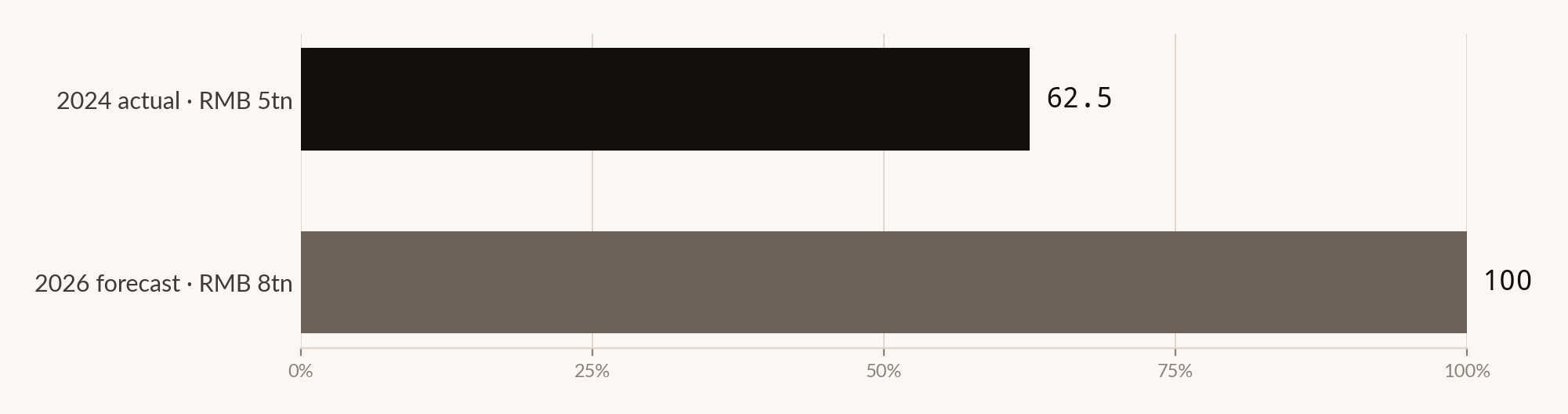
The numbers are not a niche behaviour. China's e-commerce livestreaming GMV reached approximately RMB 5 trillion in 2024 - around $807 billion - and is forecast to clear RMB 8 trillion, over $1 trillion, in 2026.2
A currency inconsistency worth stating
The two USD figures in circulation do not use the same exchange rate. RMB 5 trillion converted to $807bn implies roughly 6.2 RMB to the dollar. RMB 8 trillion converted to "over $1 trillion" implies around 8.0 RMB to the dollar.
Both cannot be right, and neither is close to a rate that would let you compare the two years cleanly. Applying a single consistent rate, RMB 8 trillion is somewhere between $1.0tn and $1.3tn depending on which assumption you adopt - and the growth from 2024 to 2026 is 60% in RMB regardless.
Use the RMB figures for the comparison and treat the dollar conversions as approximations. We have not restated them because we cannot establish which rate each source used or on what date.
Within that market, the platform ranking has changed. Douyin has overtaken Taobao as the largest live-commerce platform, with total Douyin e-commerce GMV of approximately $487 billion in 2024, roughly half of it through livestreaming.2
And brand behaviour is following the architecture. The number of brands operating their own Douyin livestreams grew 113% year on year in 2024.2 Brands are not buying media adjacent to commerce; they are operating retail channels inside a media platform.
The search question China already answered
Feature 05 of this edition described Western marketers absorbing a structural change: an answer layer appearing above search results, compressing organic clicks, and coupling paid performance to citation status.
China went through an equivalent disruption years earlier, by a different route. Discovery fragmented into applications rather than being intermediated by a general search engine. Product research happens inside Xiaohongshu. Local discovery happens inside Meituan and Dianping. Video-led discovery happens inside Douyin and Bilibili - all of which now offer ad inventory embedded within content feeds, user reviews and location-based listings.1
The strategic consequence is the same one Western marketers are now confronting: a general-purpose search index stops being the primary route to a purchase decision. China arrived there through app fragmentation; the West is arriving through generative answers. The endpoint - discovery happening inside environments the advertiser does not control and cannot fully instrument - looks remarkably similar.
Which makes the Chinese playbook worth reading, with the caveat that the two markets got there for different reasons and the transferable lessons are narrower than they first appear.
What the closed loop costs
Everything above reads as an argument that China's architecture is superior. It resolves attribution, fuses content and commerce, and produces trillion-dollar transaction volumes. It is worth being clear about what is surrendered to get it.
1. The advertiser owns nothing
In a closed loop, the customer relationship, the transaction data, the audience and the creative performance history sit inside the platform. Not shared with it - inside it. There is no equivalent of an advertiser-owned analytics property holding a complete record.
The principle that a client should retain their accounts, data and dashboards - standard in Western performance marketing and a competitive claim for many agencies - is structurally unavailable. You cannot take your Douyin commerce history to a different platform, because the history is a property of the platform, not of you.
2. Pricing power sits entirely with the platform
An advertiser operating across Google, Meta and retail media has poor measurement but real optionality: when one auction reprices, budget can move. Feature 01 of this edition documented exactly that - Microsoft's CPCs rising 12% while Google's stayed flat, and advertisers responding.
Inside a closed loop where discovery, transaction and fulfilment are the same company, that optionality does not exist in the same form. Moving platforms means rebuilding the storefront, the content history, the customer relationships and the logistics integration simultaneously.
3. Measurement clarity is not the same as measurement independence
This is the subtlest cost and the most important. Closed-loop attribution is clean, complete and entirely marked by the party selling the media.
The Western attribution problem is genuinely painful, but it has produced an entire discipline of independent verification - incrementality testing, geo holdouts, media mix modelling - precisely because nobody trusted the platform's own numbers. Feature 02 of this edition showed why that mattered: 640 incrementality tests found manual campaigns beating an automated product that reported a 15–25% ROAS advantage.
A closed loop removes the measurement gap by removing the second opinion.
If a Chinese platform's closed-loop attribution overstates its own contribution, there is no structural mechanism by which an advertiser would discover it. The number is complete, internally consistent, and unfalsifiable.
| Western open stack | Chinese closed loop | |
|---|---|---|
| Attribution | Inferred across boundaries, contested | Structural, complete |
| Content-to-purchase distance | Multiple systems, multiple drop-offs | Zero - same screen |
| Independent verification | Mature - incrementality, geo, MMM | Structurally difficult |
| Data ownership | Advertiser can retain accounts and data | Resides with the platform |
| Budget portability | Real - budget moves between auctions | Constrained by ecosystem lock-in |
| Pricing power | Competitive across sellers | Concentrated in the platform |
| Operating complexity | High - many systems to reconcile | Low - one environment |
What actually transfers
The temptation with China analysis is to conclude that the West should build closed loops. Some of it is already happening - Amazon's ecosystem, Meta's in-app checkout attempts, TikTok Shop - and the pattern of concentration described in Feature 03, where two retail media networks take 89% of incremental spend, is a move in that direction.
But three things transfer more usefully than the architecture itself.
Content and commerce belong in the same place, not in the same funnel. The Chinese lesson is not livestreaming specifically. It is that separating "the content that creates demand" from "the place demand is fulfilled" introduces a boundary, and every boundary costs conversion and costs measurement. Western marketers still routinely design campaigns where the interesting content lives in one place and the transaction lives on another.
Brands operating channels beats brands buying placements. Douyin brand-operated livestreams growing 113% in a year is a shift from media buying to channel operating. The equivalent in Western markets - brands running persistent owned presences inside commerce platforms rather than campaigns adjacent to them - is under-built relative to the opportunity.
Fragmented discovery requires fragmented presence. China's discovery landscape splintered into Xiaohongshu, Douyin, Meituan and Dianping, and brands adapted by maintaining genuine presence in each rather than optimising one channel. Western discovery is fragmenting now, through AI answers rather than apps. The adaptation required is structurally similar.
What does not transfer is the attribution comfort. A Western marketer reading about closed-loop attribution should not conclude that their measurement problem is a failure of will. It is a consequence of an open architecture that also delivers portability, competition and independent verification - three things worth paying a measurement tax for.
| Measure | Figure | Note |
|---|---|---|
| Market | ||
| China digital ad spend, 2030 forecast | $266.6bn | Alibaba, Tencent, ByteDance take the majority |
| Livestream commerce | ||
| GMV, 2024 | RMB 5tn | ~$807bn at the rate used by that source |
| GMV, 2026 forecast | RMB 8tn | Over $1tn; +60% in RMB terms |
| Douyin | ||
| Total e-commerce GMV, 2024 | ~$487bn | Overtook Taobao as largest live-commerce platform |
| Share via livestream | ~50% | Reported as "roughly half" |
| Brands running own livestreams | +113% | Year on year, 2024 |
| Ecosystem | ||
| Closed-loop operators | 4 | Alibaba, Tencent, ByteDance, JD.com |
| Embedded-inventory platforms | 4+ | Xiaohongshu, Meituan, Dianping, Bilibili |
Three questions worth asking about your own stack
How many boundaries does your purchase journey cross, and what does each cost? Count them literally - ad platform to site, site to checkout, checkout to CRM. Each is a place where both conversion and measurement leak. Most Western marketers have never counted, and the number is usually three or four.
Where are you buying placements when you could be operating a channel? The Douyin brand-livestream number describes a shift in posture rather than budget. A persistent owned presence inside a commerce environment behaves differently from a campaign pointed at one.
What would you lose if your measurement became perfect but unverifiable? This is the trade the closed loop makes. It is worth knowing whether you would take it, because Western platforms are incrementally offering versions of the same bargain - cleaner attribution in exchange for operating inside their walls.
How we did this
What this doesn't prove
- That closed-loop attribution is accurate. It is complete and internally consistent. Whether it correctly represents incremental contribution is unknowable from outside, which is precisely the argument made in the piece.
- That China's model outperforms the Western one. Different architectures with different trade-offs. Higher transaction volume in a market of 1.4 billion people is not evidence of a superior advertising model.
- Any of the GMV figures to a useful precision. Chinese platform GMV is inconsistently defined, rarely audited and reported through intermediaries. The magnitudes are directionally credible; the specific numbers should not be modelled on.
- That app-based discovery fragmentation and AI-answer disruption are equivalent. We argue the strategic endpoint is similar. The mechanisms, the timelines and the competitive dynamics differ substantially, and the analogy should not be pushed past the point made.
- Anything about Chinese consumer behaviour. This feature is about market architecture. It makes no claim about why Chinese consumers buy in livestreams, and cultural explanations are outside what the data supports.
- Anything about TikTok Shop's Western prospects. Douyin operates in a different regulatory, logistical and payments environment. Douyin's performance is not a forecast for TikTok.
Sources for this feature
- China digital market and platform ecosystem analysis, 2026, via industry coverage. digitalinasia.com A named study, reported by someone else
- China live commerce market analysis and platform GMV, via e-commerce market research. ecdb.com A named study, reported by someone else
- China digital ad spend forecast to 2030, market research summary via trade press, 2026. From a company that sells into this market - vendor research summary
- Features 01–05 of this edition, for the Western measurement picture. Another feature in this edition