
Two figures from the same body of 2026 research, and between them they describe the most consequential change to organic marketing in a decade.
Only 38% of AI Overview citations come from pages ranking in Google's top ten, down from 76% in prior measurements.1
Eighty per cent of citations across the major language models come from pages that do not rank in Google's top hundred for the original query.1
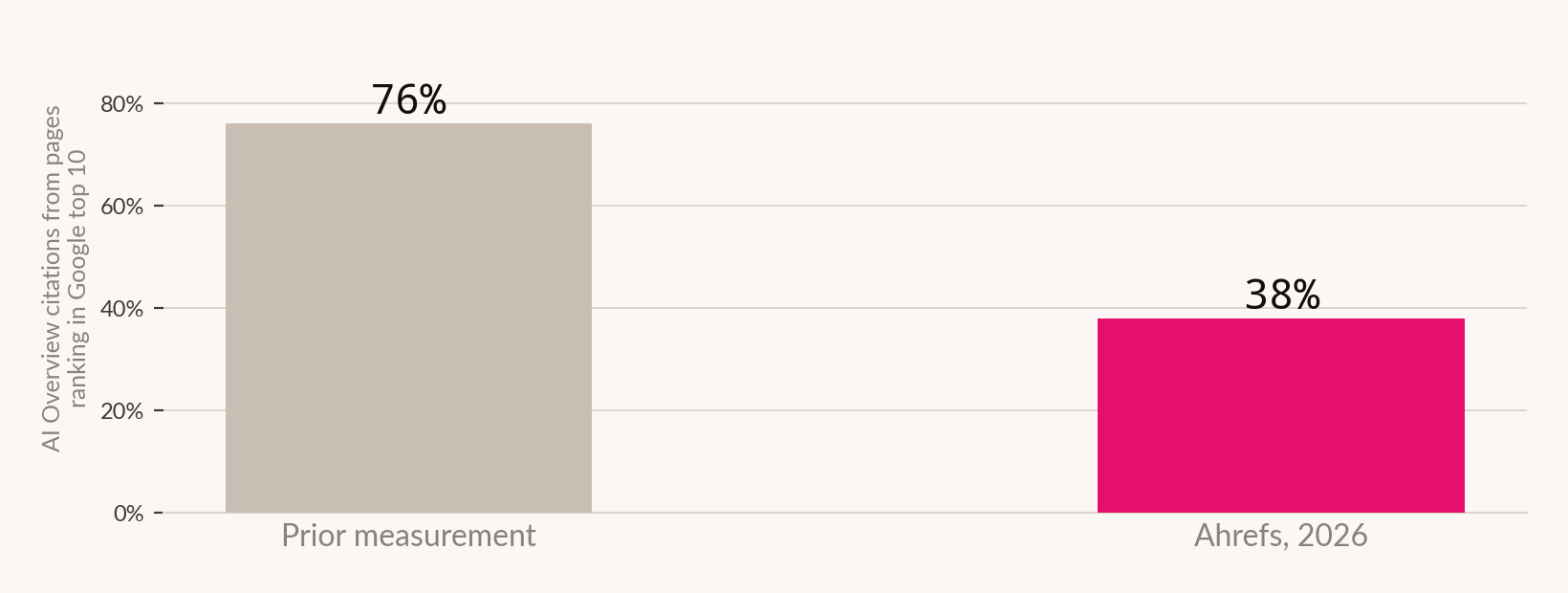
Read together, they say something uncomfortable. Ranking and being cited have decoupled. They were once close to the same thing - if you held position three, you were the source the summary drew on. That relationship has weakened by half in a single measurement cycle.
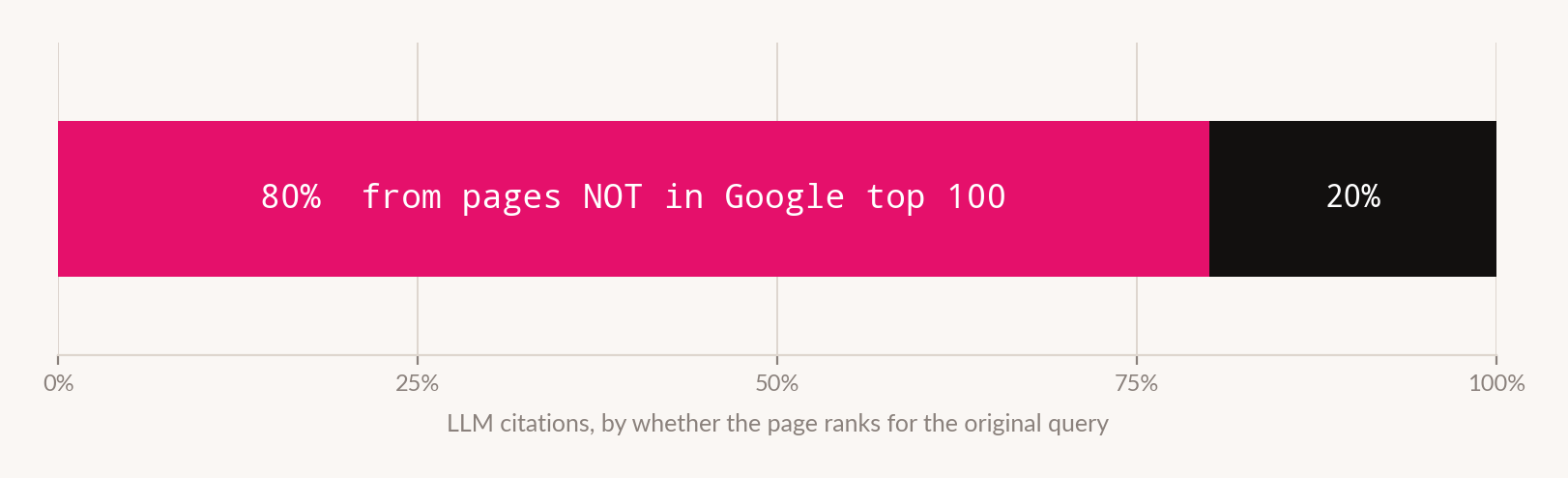
Four citations in five come from pages that, by the ranking system's own account, are not among the hundred best answers to the question.
What the discipline was actually optimising
Search optimisation, as practised for twenty years, rests on a chain of assumptions. Rank higher, receive more clicks, receive more customers. Every technique in the discipline - keyword targeting, internal linking, page speed, backlink acquisition - attaches to the first link in that chain, because the rest followed from it automatically.
Feature 21 of this desk removed the second link: the click no longer follows the rank at anything like the previous rate. This feature removes the first one. If citation is the new distribution and ranking predicts 38% of it, then the entire apparatus is optimising a variable with weak explanatory power over the outcome.
That is not an argument that ranking is worthless. Twenty per cent of LLM citations do come from ranked pages, AI Overviews still favour top-ten pages at nearly four times chance, and search still delivers real traffic for transactional and navigational intent. It is an argument that ranking has gone from being nearly sufficient to being one input among several, and that the discipline's instrumentation has not caught up.
Why a model would cite an unranked page
The mechanism is worth understanding because it tells you what to do. Ranking answers the question "which page best satisfies this query". A language model is doing something else: it is assembling an answer from material it has ingested, and reaching for whatever passage most cleanly supports the specific claim it is making at that moment.
Those are different selection problems. A page can be an excellent source for one sentence inside an answer while being a poor overall response to the query - a methodology note, a data table, a single well-stated definition buried in a longer document. Ranking systems evaluate documents. Generative systems extract passages.
This is the practical shift: the unit of optimisation moved from the page to the passage.
The demand side is growing
It would be easy to read this desk as describing a contraction. The distribution figures are all negative. The usage figures are not.
AI search visits reached 27.4 billion queries in Q1 2026, growing 42.8% year over year.2
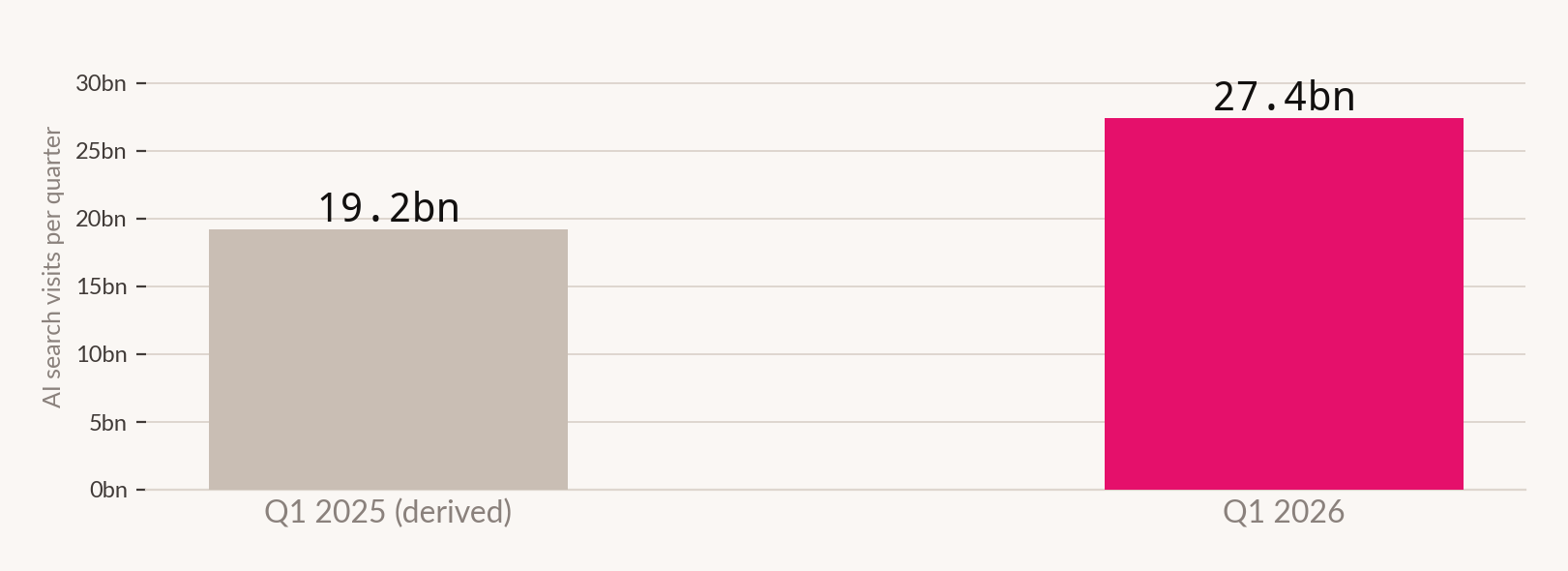
A channel adding eight billion quarterly queries is not a niche. It is the fastest-growing discovery behaviour in the market, and the reason the citation question matters commercially rather than academically.
Set the two halves together and the strategic picture is clearer than either alone. Demand for answers is growing sharply. The mechanism that used to convert that demand into a visit has weakened. And the selection rule governing which sources feed the answers has changed underneath the discipline built to influence it.
An organisation reading only the traffic figures concludes the market is shrinking and cuts. An organisation reading both concludes the market is growing and its access route changed - which implies a completely different response.
The measurement problem this creates
A discipline that has lost its leading indicator needs a new one, and the candidate is citation share - the proportion of AI-generated answers in a category that name a given brand.2
The appeal is obvious: it measures the thing that now happens instead of the click. The difficulties are equally real and mostly unacknowledged in the vendor material promoting it.
The honest position is that citation share is the best available proxy for a thing that genuinely matters, with none of the validation that would let anyone target it confidently. That is roughly where rank tracking sat in 2004, and the discipline built a great deal on it before establishing whether it worked.
Whose interest this serves
Most published material on citation share and generative optimisation comes from vendors selling citation-tracking tools and agencies selling the associated service. A finding that ranking no longer predicts citation is commercially useful to anyone selling a replacement for rank tracking. The two Ahrefs-derived figures at the top of this feature come from a company that sells SEO tooling and therefore has an interest running the other way - which is part of why we weight them. Marketing Legendary operates a content practice and benefits from the conclusion that this requires new work.
What this changes in practice
Write passages that can stand alone. If extraction is at the passage level, then a claim, its number and its source need to sit adjacent in the text. A finding whose support is three paragraphs away is harder to lift cleanly, and a passage that cannot be lifted cleanly is less likely to be used.
Publish the thing only you have. Eighty per cent of citations coming from outside the ranked set means the selection is not about competing on a crowded query. Proprietary data, original method and specific numbers are citable precisely because no synthesis can produce them from other sources.
Keep ranking work, but reclassify it. It still delivers transactional traffic and still accounts for a fifth of LLM citations. It is no longer a proxy for total organic visibility, and reporting it as one is the error.
Instrument citation before you optimise for it. Establish where you are named today across the models that matter to your buyers. Without a baseline, the changes you make in the next two quarters will be unattributable.
Do not buy a citation-share target. No published research links the metric to revenue. Track it, learn its behaviour, and resist putting it in a compensation plan until someone has demonstrated it means something.
| Measure | Value | Grade |
|---|---|---|
| The decoupling | ||
| AI Overview citations from top-10 rankers, 2026 | 38% | Reported |
| Same, prior measurement | 76% | Reported, date unstated |
| Change | −38pp | Our arithmetic |
| LLM citations from pages outside Google top 100 | 80% | Reported |
| LLM citations from ranked pages | 20% | Complement |
| Context | ||
| AI search visits, Q1 2026 | 27.4bn | Reported |
| Year-over-year growth | +42.8% | Reported |
| Not established | ||
| Citation share linked to revenue | - | No research located |
| Standard sampling frame for citation measurement | - | None exists |
How we did this
What this doesn't prove
- That ranking no longer matters. A fifth of LLM citations come from ranked pages, and search still serves transactional intent. The claim is that ranking is no longer a sufficient proxy, not that it is worthless.
- That citation drives revenue. No study we found connects being cited to any commercial outcome. The whole strategic case for optimising it currently rests on plausibility.
- Why models cite unranked pages. The passage-extraction explanation is our reasoning about mechanism. No source demonstrates it.
- That the 38% will keep falling. Two points do not establish a trajectory, and we do not know the date of the first one.
- How the figures differ across models. The 80% is aggregated across systems that behave differently. A per-model breakdown would probably change the advice and is not available.
- That passage-level writing improves citation. It follows from the mechanism if the mechanism is right. It has not been tested.
Sources for this feature
- Ahrefs citation data and LLM citation analysis, 2026, via industry coverage. writer.com, instantpress.co, emarketer.com A named study, reported by someone else - vendor research via secondary coverage
- Citation share methodology and AI search volume, 2026. omnibound.ai, authoritytech.io From a company that sells into this market - vendor, cited as subject
- Features 21, 23 and 26 of this edition. Another feature in this edition